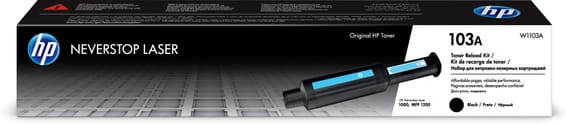
280 grams for 2,500 pages
The figure is worth stating, because it says exactly what you are buying. On a cartridge printer, most of a consumable's bulk and weight is the shell: the cylinder, the rollers, the gears, the chip. The powder is only a fraction of it, and all the rest goes in the bin at replacement time.
Here, there is only the powder. A 280-gram bottle, fitted onto the hatch and emptied into the machine's reservoir. Nothing else to throw away but an empty container, nothing to align, no part to handle. That also makes the reload easy to store: you can keep two in a drawer without giving up any space.
The drum, by contrast, is a real part
At 1.58 kg, the 104A drum is of another order: it is the mechanical equivalent of what usually gets thrown away with every cartridge, except that here it stays in place and serves eight reloads in a row. So it is not replaced at the toner's pace, and it is not ordered at the same time.
The rule of thumb is simple: powder is watched in printed pages, the drum in tens of thousands. As long as prints come out crisp, there is nothing to change on that side.
A printer on its own, on Wi-Fi
The 1000w prints, and that is all: no scanner, no copier, no document feeder. It connects over Wi-Fi or USB, takes 150 sheets and turns out 20 pages per minute, for a recommended monthly volume of 250 to 2,500 pages.
On the scale of a reload, that means a 103A kit covers anything between a month of heavy use and close to a year of occasional use. Nothing that comes out of this machine was triggered by a copy: it all comes from a workstation or a phone, which makes its consumption more predictable than a multifunction's.
A fleet of printers to keep supplied?
We draw up the list of consumables for your whole fleet and a single grouped quote. Invoice in your company's name with its ICE number, delivery anywhere in Morocco.