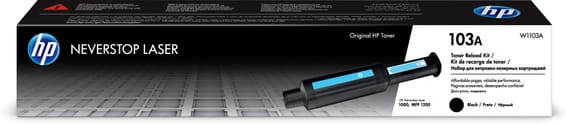
A tank laser: what that changes
The principle is that of ink tank printers, transposed to laser. There is no cartridge to pull out: you open a hatch, fit the 103A bottle, the powder goes down, you remove the empty bottle. The operation takes a few seconds and does not dirty your hands — the powder never travels in open air.
The consequences are real. There is no longer a plastic shell thrown away at every replacement, no chip, and the 2,500-page yield is obtained from far less material than a conventional cartridge. On the other hand, you cannot "shake the cartridge" to gain a few pages: when the reservoir is empty, it is empty.
There is also a twin kit (103AD), two bottles in one box, for anyone who prefers ordering less often.
The drum becomes a part in its own right
On a conventional laser of this size, the drum is built into the cartridge: every replacement brings a new cylinder, and you never think about it. Here, since there is no cartridge, the drum exists on its own and is replaced separately, about every 20,000 pages — eight 103A reloads.
That is the thing to remember about this machine: two consumables, two very different rhythms. The drum is changed when the page shows repeating marks — dots or lines coming back at the same interval — not on a fixed date. Pale areas point to an empty reservoir, never to the cylinder.
A volume to watch
HP recommends up to 2,500 pages a month, which corresponds exactly to one reload a month at the ceiling. The machine prints 20 pages per minute, holds 150 sheets, connects over Wi-Fi and shows its state on an icon display. Its maximum cycle is 20,000 pages — the life of a drum, which is no coincidence.
A fleet of printers to keep supplied?
We draw up the list of consumables for your whole fleet and a single grouped quote. Invoice in your company's name with its ICE number, delivery anywhere in Morocco.