Thick paper: the toner is not lacking, it sticks badly
On a laser, the image is not soaked into the fibre the way ink is: the powder is laid down and then fused onto the sheet by a fuser running above 150 °C. A thick or rough medium goes through that fuser faster than it heats through, and the toner sticks less well — hence prints that flake at the fold of an envelope or when a card is scratched.
This is not a cartridge problem, and changing toner will not help. What works: declaring the right media type in the driver ("heavy", "envelope", "card"). The machine then deliberately slows down to give the fuser time to do its work.
What the priority slot makes possible
The main tray holds 250 sheets for everyday use; the priority feed takes sheets one at a time, without emptying or reloading the tray. That is what makes it practical to print an envelope between two documents, or a cover on heavy paper in the middle of an ordinary run.
The weight accepted goes up to 200 gsm on suitable media. Beyond that, or on a strongly textured paper, fusing becomes unreliable whatever the setting.
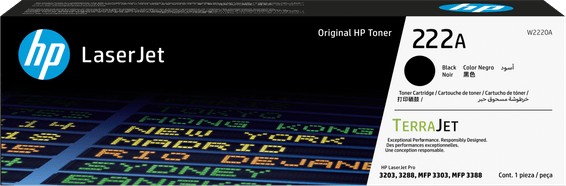
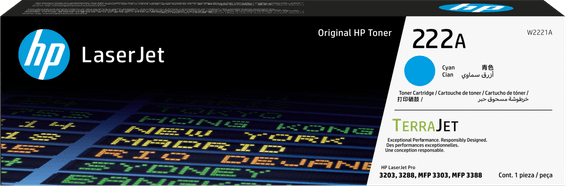
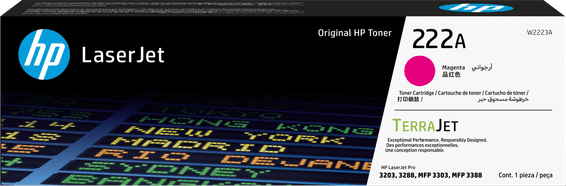
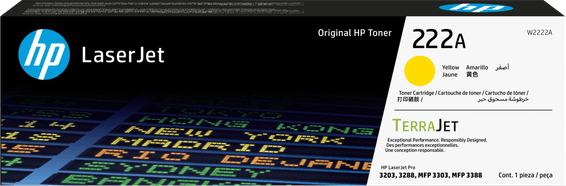
222A or 222X on a 25-page-per-minute machine
With a duty cycle of 40,000 pages a month, the 3303sdw is an office colour machine, not a standby one. The 222X multiplies each cartridge's yield by 2.5 and divides the number of times you take four toners out by as much.
The MFP 3303fdw takes exactly the same part numbers and adds fax; its page sets out the confusion between the 222A and earlier families — a trap that costs dearly at the moment of ordering.
A fleet of printers to keep supplied?
We draw up the list of consumables for your whole fleet and a single grouped quote. Invoice in your company's name with its ICE number, delivery anywhere in Morocco.