RODE NT55 Condenser Microphones - Matched Pair, 1/2" Small Diaphragm, Cardioid and Omni Capsules (NT55MP)
Two matched RODE NT55 small-diaphragm condenser microphones for stereo recording, each with its cardioid capsule and an NT45-O omnidirectional capsule. 75 or 150 Hz filter, pad down to -20 dB, 15 dBA self-noise, XLR output on 48 V phantom power.
Matched pair of small-diaphragm condenser microphones for stereo recording of acoustic instruments, drum overheads or a live performance: two matched NT55s, interchangeable cardioid and omnidirectional capsules and 15 dBA self-noise. Pickup: 1/2-inch capsule, response from 20 Hz to 20 kHz, sensitivity -38 dB re 1 V/Pa, handles 136 dB SPL Settings on each mic: 75 or 150 Hz high-pass filter and -10 or -20 dB pad Connection: XLR output, 48 V phantom power required, no cable supplied Supplied: 2 NT45-O omnidirectional capsules, 2 RM5 clips, 2 WS5 windshields and a zip pouch The matched version of the NT55, for stereo takes whose two channels answer each other.
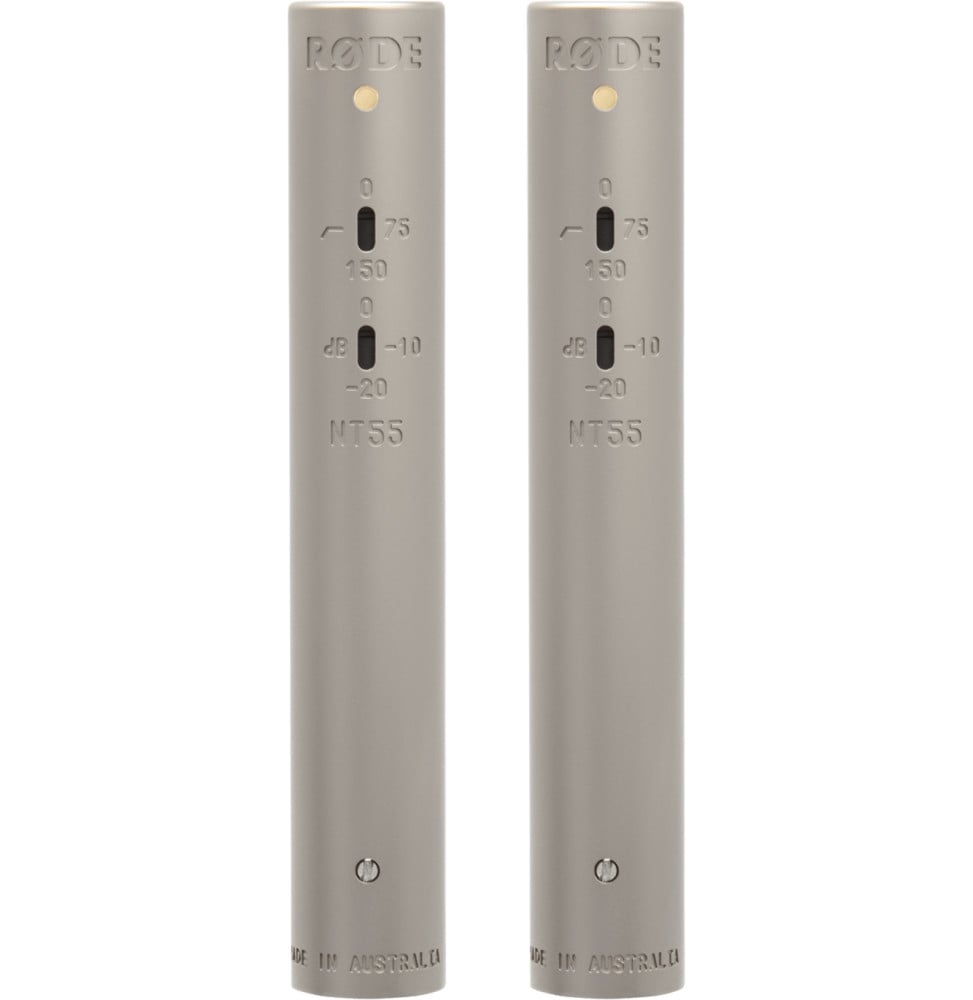
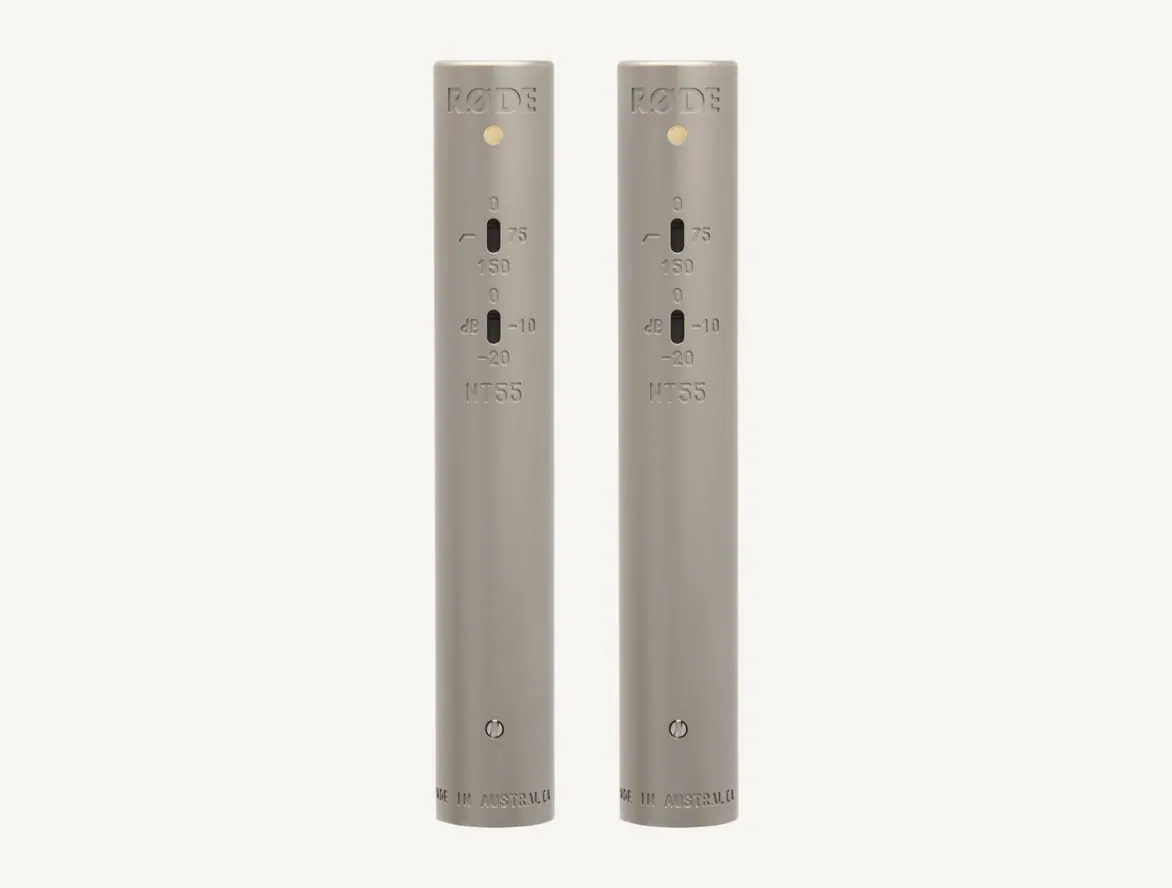
The NT55MP brings together two NT55 small-diaphragm condenser microphones, matched and certified by RØDE for stereo recording. Each one carries a 1/2-inch cardioid capsule with a gold-sputtered diaphragm, and each one comes with a second, omnidirectional capsule.
2matched mics
15 dBAself-noise
136 dB SPLmaximum pressure
20 Hz – 20 kHzfrequency response
One capsule for the direct sound, one for the room
Fitted as standard, the cardioid capsule mainly picks up what is in front of the mic and leaves aside what comes from behind: the right setting for an acoustic guitar or an instrument recorded up close. The two supplied NT45-O capsules pick up in every direction, for a room, an ensemble or an ambience take. You switch from one to the other on the body of each mic, without changing pair.
Two settings at your fingertips, on each mic
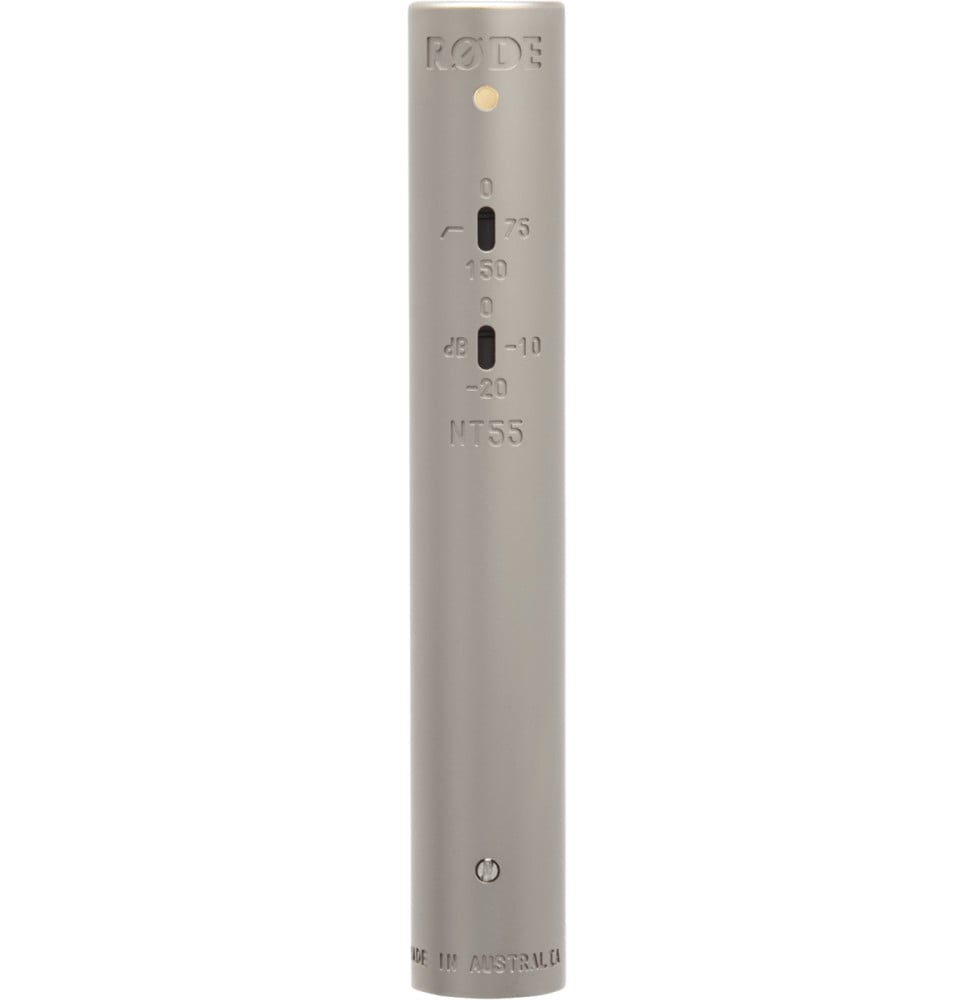
A high-pass filter switch cuts at 75 or 150 Hz, with a 12 dB per octave slope, to remove rumble and unwanted bass. A second switch attenuates the signal by 10 or 20 dB in front of a loud source, cymbals or amp, before it overloads the input. Without attenuation, each NT55 handles 136 dB SPL for 15 dBA of self-noise.
As a pair, above or in front of the source
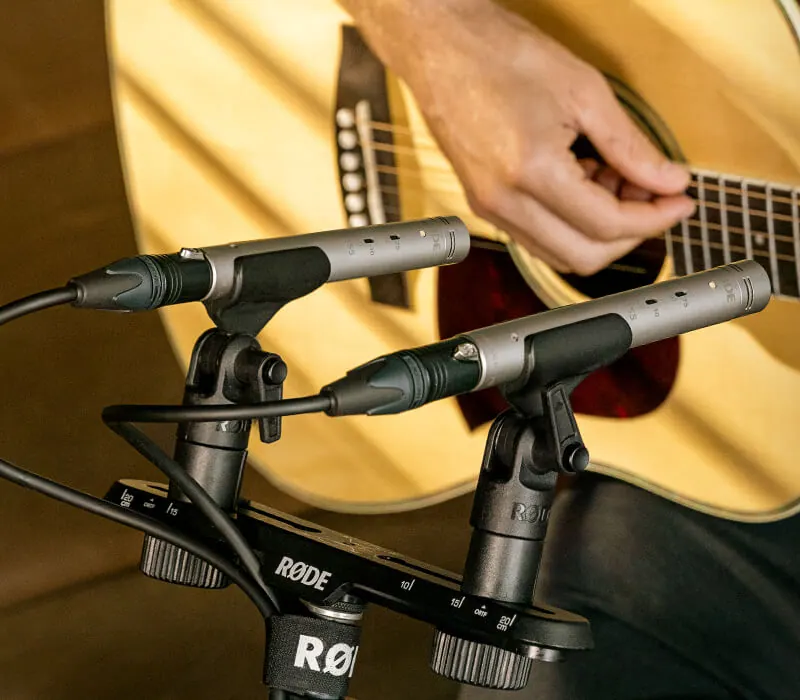
RØDE designs the NT55 for acoustic instruments, drum overheads and cymbals, live performances and on-location dialogue. As a pair, the two mics sit side by side in front of the guitar, above the kit or facing the stage, and deliver the two channels of a single stereo image. Each mic has an XLR output and is set independently.
Each NT55 requires 48 V phantom power: for the pair, you need two XLR inputs with phantom power and two XLR cables, which are not supplied. The stereo bar in the photo above is not supplied either.
Everything that is in the box
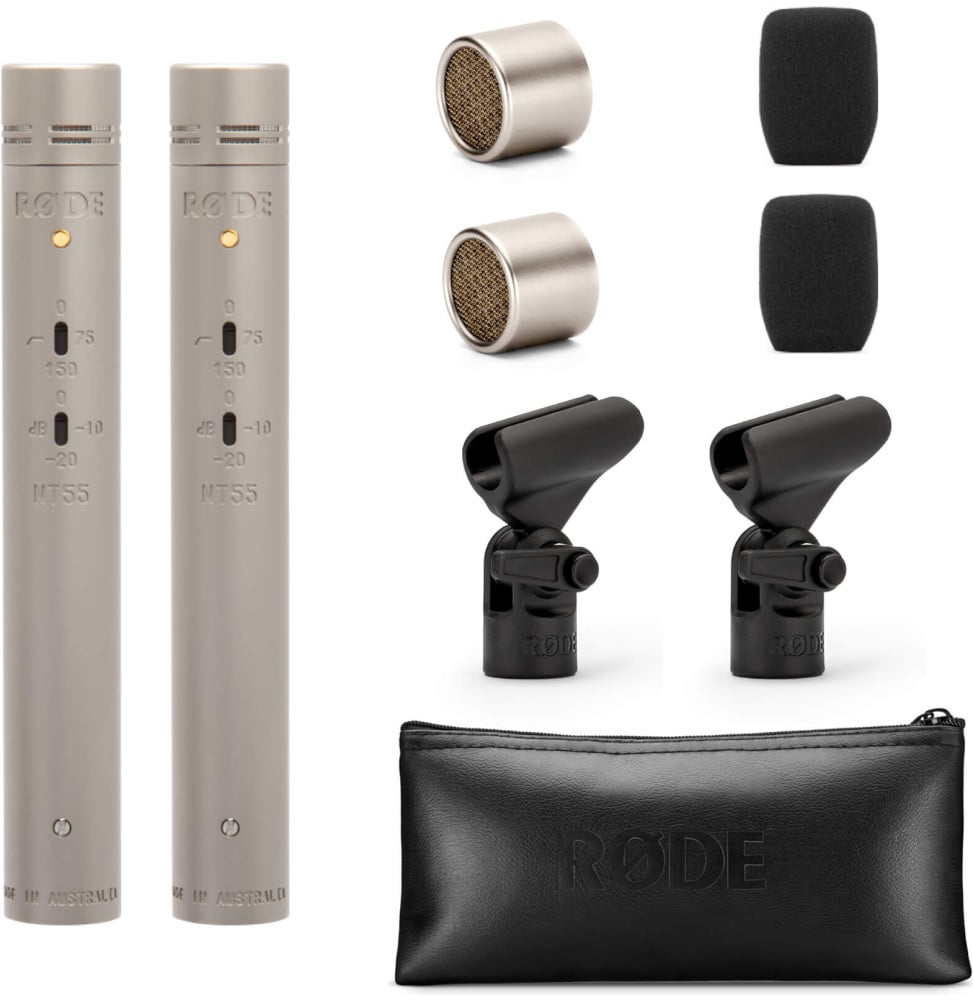
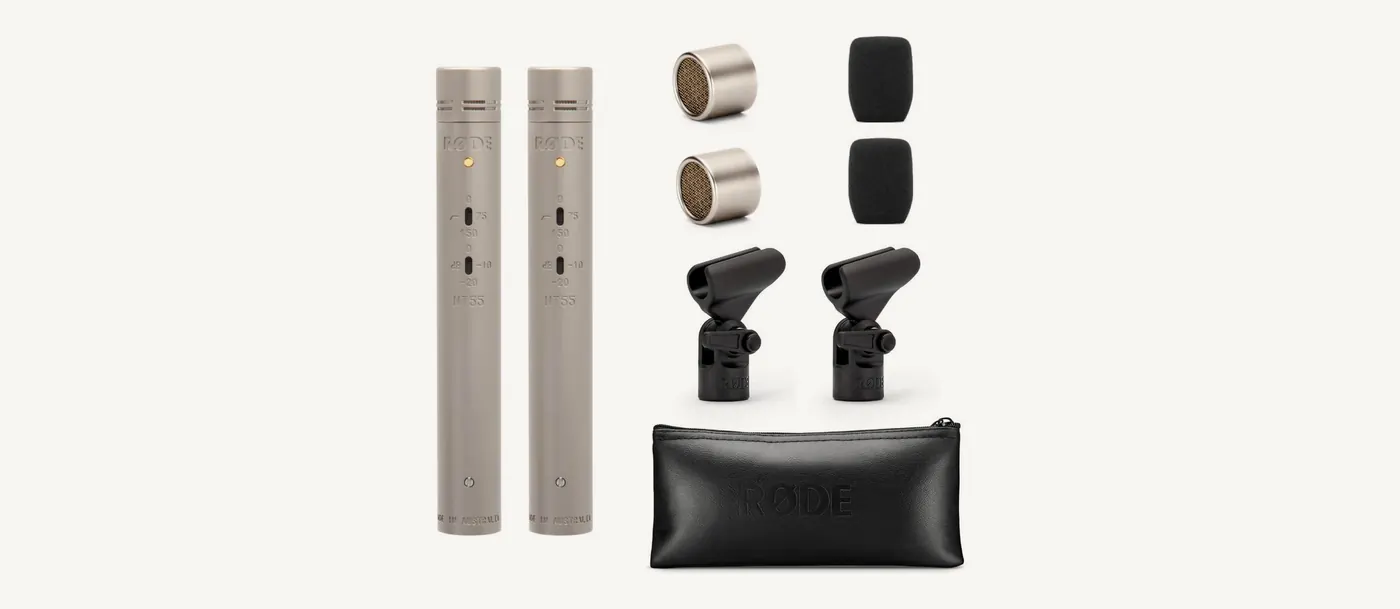
The two NT55s with their cardioid capsule, two NT45-O omnidirectional capsules, two RM5 clips for a mic stand, two WS5 foam windshields against breath noise and a ZP1 zip pouch to store it all.
Two NT55s, two NT45-O capsules, two WS5 windshields, two RM5 clips and the ZP1 pouch.
Be the first to review this product and help other customers.
Write a review
Frequently asked questions about this product
What does “matched pair” mean for the RODE NT55MP?
They are two acoustically matched NT55s, certified by RØDE for stereo recording and sold together. You set them up as a pair in front of an acoustic instrument or above a drum kit for a two-channel take. Each mic can still be used on its own, with the same filter and pad settings.
What are the NT45-O capsules supplied with the NT55MP for?
Each NT55 comes with its cardioid capsule fitted and an NT45-O omnidirectional capsule, so two NT45-O in the box. The cardioid capsule mainly picks up what is in front of the mic; the NT45-O picks up all around, for the ambience of a room or an ensemble. The capsules are interchangeable: you swap one for the other on the body of the mic.
Does the RODE NT55 work without phantom power?
No. It is a condenser mic: each NT55 must receive 48 V phantom power (P48) through its XLR cable, supplied by an audio interface, a mixing desk or a preamp. For the pair, you therefore need two XLR inputs with phantom power. No XLR cable is supplied in the box.
What are the high-pass filter and pad of the NT55 for?
Two switches on each mic. The high-pass filter cuts at 75 or 150 Hz, 12 dB per octave, to remove rumble and unwanted bass. The pad lowers the level by 10 or 20 dB in front of a very loud source, drums or amp, so as not to overload the input. Without the pad, the NT55 handles 136 dB SPL.
What is in the RODE NT55MP box?
Two NT55 microphones with their cardioid capsule, two NT45-O omnidirectional capsules, two RM5 clips, two WS5 foam windshields and a ZP1 zip pouch. There is no XLR cable, stand or stereo bar: plan for them to set up the pair in front of the source.
Which sources is the NT55 designed for?
RØDE designs it for acoustic instruments, drum overheads and cymbals, live recording and on-location dialogue. Its 1/2-inch capsule covers 20 Hz to 20 kHz with 15 dBA of self-noise, which suits delicate sources as well as loud ones thanks to the pad.
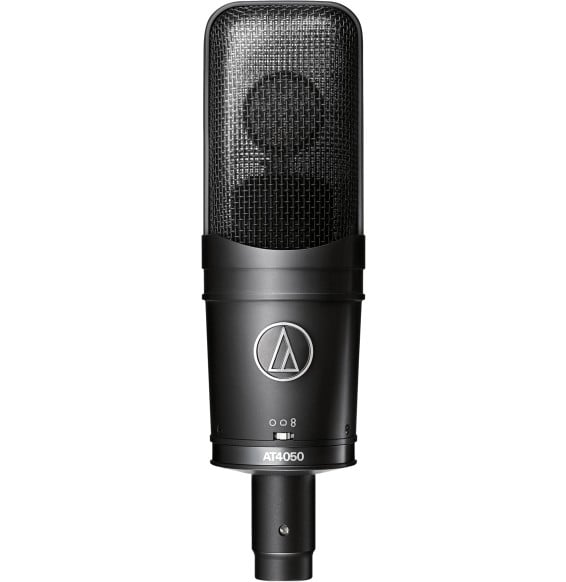
A dual-diaphragm studio condenser microphone with three polar patterns: cardioid, omnidirectional and figure-of-eight. Transformerless, it handles 149 dB SPL with 17 dB of self-noise and serves vocals, piano, strings and amps; AT8449a shock mount included.
A dual-diaphragm studio condenser microphone with three polar patterns: cardioid, omnidirectional and figure-of-eight. An 80 Hz filter, a -10 dB pad and 149 dB SPL handling suit it to vocals, piano, strings and amps, in the studio as on stage.
A large diaphragm that flatters the spoken and sung voice, and a 144 dB SPL handling that copes with a guitar amp or a snare drum. It connects to an audio interface or a desk able to supply +48 V.
A cardioid electret studio microphone, transformerless, with a 2-micron diaphragm aged in 5 steps. It handles 145 dB SPL, 155 dB SPL with the pad, with 17 dB of self-noise, and comes with its AT8449a shock mount and protective case.
A large-diaphragm cardioid studio condenser microphone for vocals, instruments and podcasts. It handles 148 dB SPL with 12 dB of self-noise, connects over XLR to a phantom power source and comes with its AT8458 shock mount.
A large-diaphragm cardioid condenser studio microphone for vocals and instruments. It handles 145 dB SPL with 12 dB of self-noise, and its Hemisphere plug-in, obtained when the microphone is registered, gives it the tone of eight classic studio microphones.
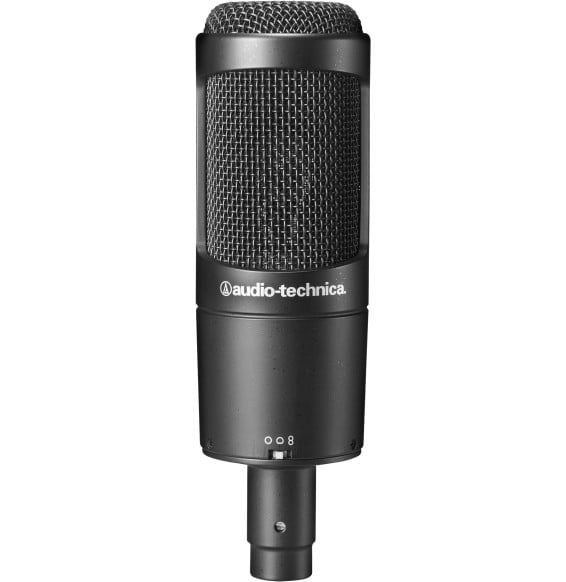
Large-diaphragm 25 mm condenser mic for vocals, guitar and podcasts: cardioid pattern, class A FET preamp and 135 dB maximum SPL. It connects over XLR to an interface supplying 48 V; rigid mount and carrying bag included.
Fed with +48 V phantom power from an audio interface or a mixing desk, this home-studio classic suits the voice as well as acoustic instruments. Steel body, swivel mount and carrying pouch included.
•+48 V phantom power required: audio interface or mixing desk
A large-diaphragm cardioid studio condenser microphone with transformerless electronics. 12 dB SPL self-noise, 145 dB SPL handling, 80 Hz filter and -10 dB pad; it comes with the AT8449a shock mount, a dust cover and a protective case.
Two gain steps, +18 or +28 dB, delivered by the on-board preamp: any interface can keep up, even on a soft voice. A switch bypasses it to return to the original behaviour of the SM7B.