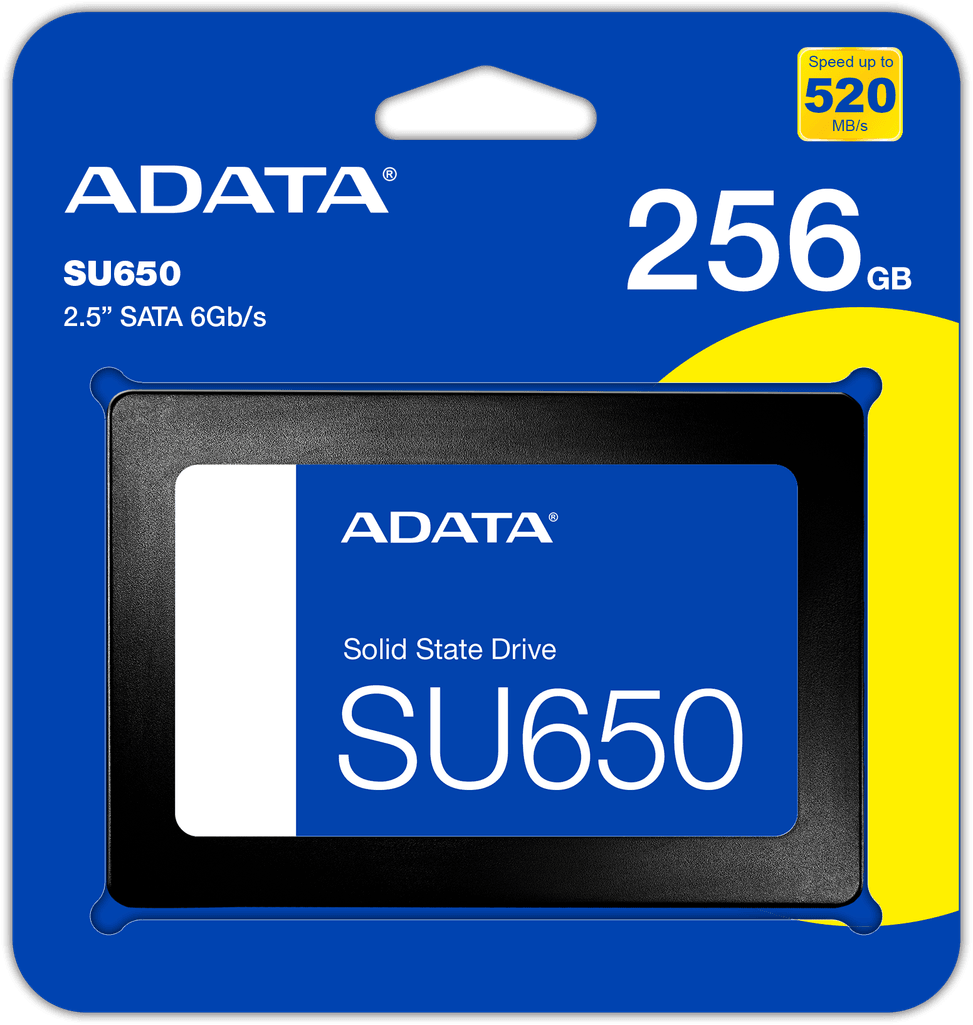
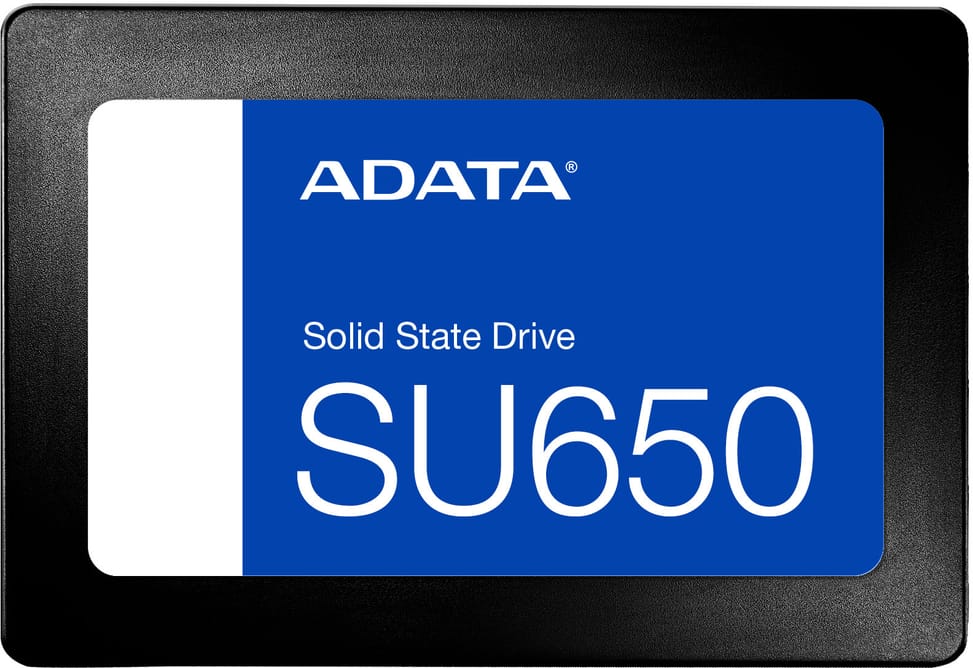
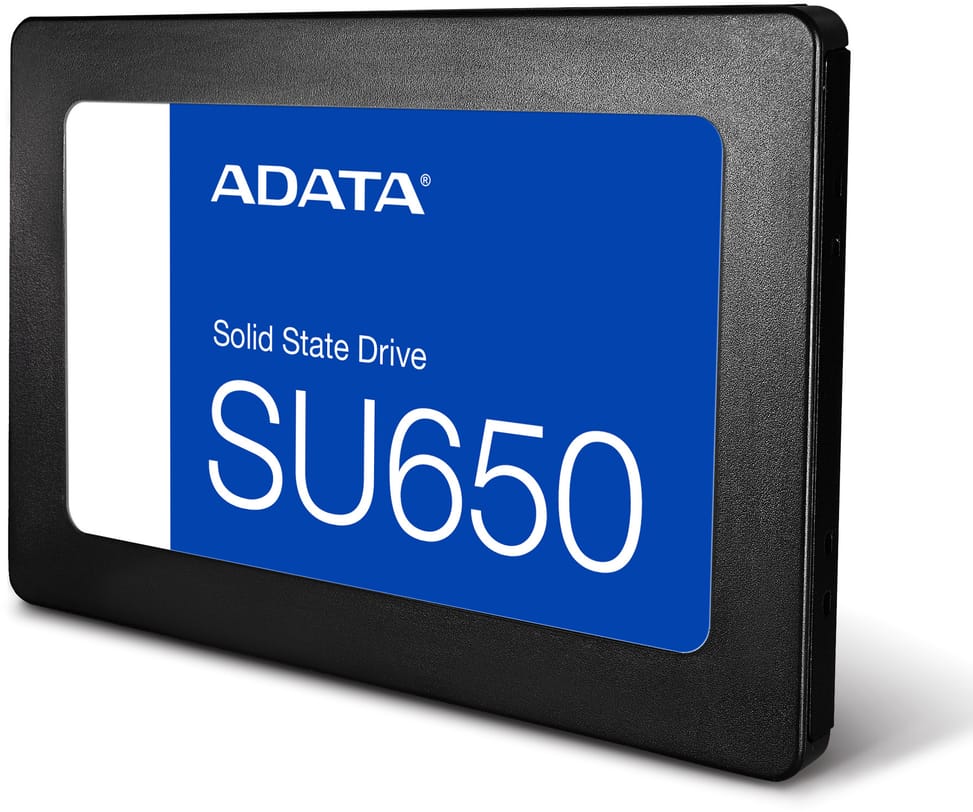
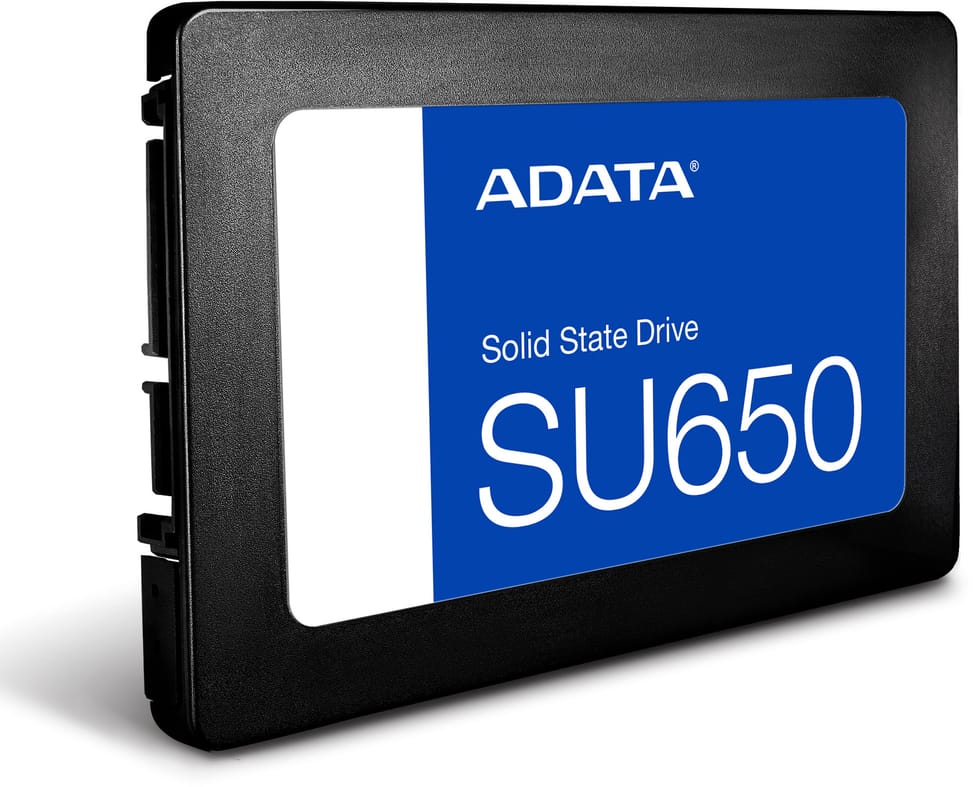
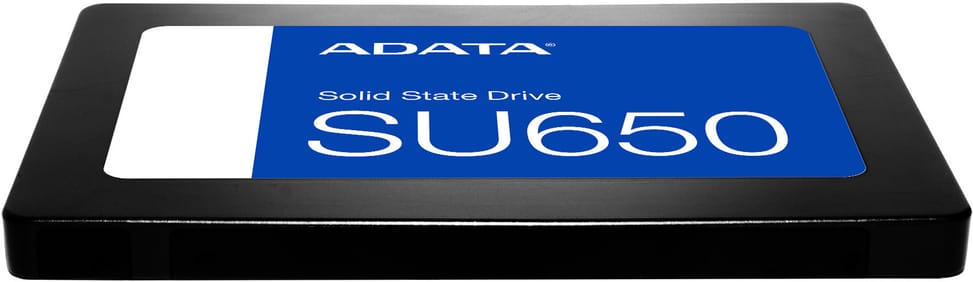
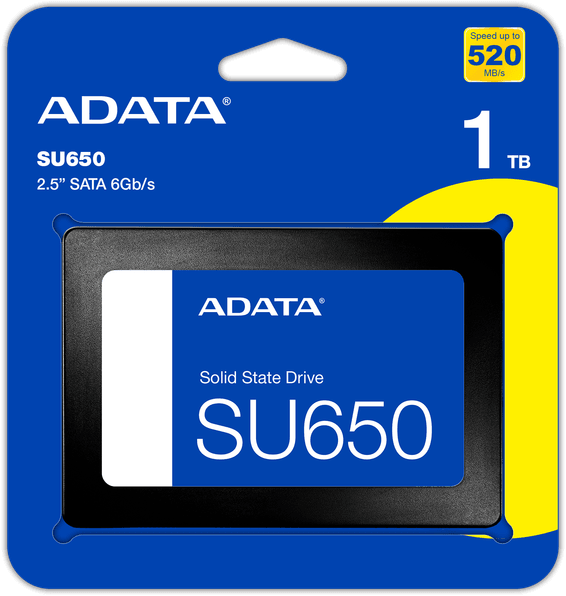
520 MB/s reading and 450 MB/s writing to replace a spinning hard drive with no noise and no vibration. 3D NAND memory, SLC cache and ECC error correction; the ADATA migration utility copies the whole system onto the new drive.
Sequential reading up to 520 MB/s
Sequential writing up to 450 MB/s
SATA III 6 Gb/s interface, backwards compatible with SATA II
7 mm thick, for desktop PCs as well as laptops
Endurance 140 TB written (TBW)
Up to 40,000 IOPS in 4K random reading and 75,000 in writing
ADATA Ultimate SU650 256 GB SSD, 2.5" 7 mm form factor, SATA III 6 Gb/s interface: the easy upgrade that brings back smooth performance to your laptop or desktop PC, day in, day out. Compatibility: standard 2.5" 7 mm form factor (laptops and desktops), SATA III 6 Gb/s interface, backward compatible with SATA II, Windows, macOS and Linux. Technology: 3D NAND memory, SLC caching to speed up transfers, ECC error correction, SSD Toolbox software and ADATA migration utility included. Performance: read speeds up to 520 MB/s, write speeds up to 450 MB/s, 4K random IOPS up to 40K read and 75K write. Endurance: TBW 140 TB, MTBF 2,000,000 h. Ideal for replacing a slow hard drive, upgrading an office laptop, adding a second system drive or setting up a spare PC. A simple, silent and reliable upgrade that puts the pep back into your machine.
Be the first to review this product and help other customers.
Write a review
Frequently asked questions about this product
Will I have to reinstall Windows after fitting this SSD?
No. ADATA provides a free migration utility that copies the entire original drive, operating system included, to the SU650: you pick up where you left off, with your software and files already in place. The SSD Toolbox suite is offered for download at the same time.
How much data can be written to it before it wears out?
The 256 GB version is rated for 140 TB written (TBW), with an MTBF of 2,000,000 hours, 25% more than a 2D NAND SSD. This endurance is specific to this capacity: it rises to 280 TB on the 480 and 512 GB models. The wear consumed can be monitored at any time in SSD Toolbox.
Can you monitor the drive's wear and health over time?
Yes, with SSD Toolbox, ADATA's free utility: it reads the S.M.A.R.T. attributes, displays the drive's health and remaining lifespan, operating temperature and space used, and automatically installs firmware updates.
Does this SSD fit in a motherboard M.2 slot?
No: it is a 2.5-inch drive that connects via SATA III 6 Gb/s. It measures 100.45 × 69.85 × 7 mm, the standard thickness for laptop and desktop PC drive bays. So make sure you have a free 2.5-inch bay.
Does it work in an older PC with SATA II?
Yes, the SATA III 6 Gb/s interface is backward compatible with SATA II: the transfer rate will then be limited by the machine's port, but the drive remains fully usable, under Windows as well as macOS or Linux. It is precisely when replacing a slow hard drive that the gain is most noticeable.
What speeds can you expect from the 256 GB version?
Up to 520 MB/s read and 450 MB/s write sequentially, and in 4K random access, 40,000 IOPS read and 75,000 IOPS write. These are the figures announced specifically for the 256 GB capacity, not for the top of the series.
What does the SU650's SLC cache actually do?
It makes the NAND flash memory work in single-level cell mode during transfers, which maintains the maximum speeds of 520/450 MB/s. System boot, file copies and downloads benefit directly, in everyday use.
Is it more resistant than a traditional hard drive in a laptop that travels?
Considerably. With no mechanical parts at all, it withstands shocks of 1,500 G over 0.5 ms, tolerates vibration and operates from 0 to 70 °C. It is also completely silent, uses very little power, and can be stored at -40 to 85 °C.
What does ECC error correction do, and why does it matter?
ECC detects and corrects errors on the fly: it protects the integrity of your data and extends the life of the SSD. Combined with 3D NAND flash, it accounts for the announced MTBF of 2 million hours, 25% higher than that of a 2D NAND SSD.
Can it be installed as a second drive, alongside the existing system drive?
Yes. It is designed both to replace a slow hard drive and to serve as a second system or data drive, in an office laptop as well as in a spare PC. It weighs just 47.5 g, is completely silent and uses very little power.
How can I be sure to receive the 256 GB version of this SU650?
The reference on this product page is ASU650SS-256GT-R, that of the 256 GB model in the Ultimate SU650 series. The range also includes 120, 240, 480, 512 and 960 GB versions, whose write speeds and endurance differ — the 120 GB, for example, tops out at 320 MB/s write.
Is the drive new and under warranty?
Yes: new in its original packaging, reference ASU650SS-256GT-R, supplied with its invoice, which serves as the warranty document for 1 year. Performance details for each capacity are given in the ADATA datasheet (PDF).
Compatible with a desktop PC, a laptop and a PS4 alike, it reads at 530 MB/s and writes at 400 MB/s. 3D NAND memory with no moving parts, for an office machine that is finally responsive.
Short enough to fit an ultra-thin laptop or a handheld games console, and it weighs only 2.6 g. 5,000 MB/s read, 3,000 MB/s write, low power draw and 160 TB written of endurance.
Ten times faster than a spinning drive: 500 MB/s read, 350 MB/s write, enough to wake up a machine that drags at start-up. With no moving parts, it takes the knocks and vibration of a computer on the move.
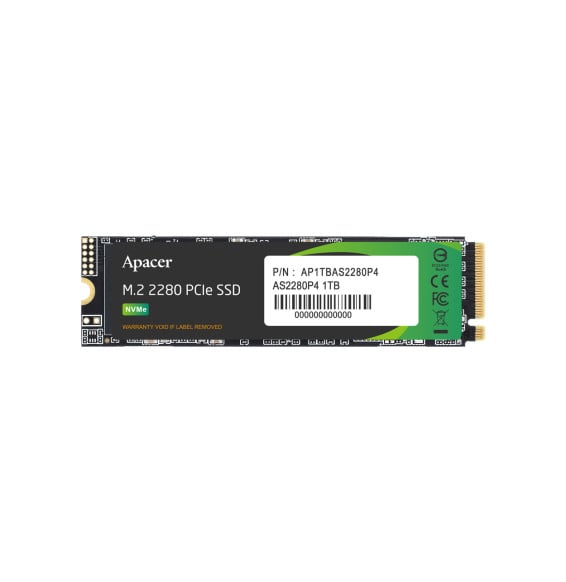
Apacer AS2280P4 256 GB internal SSD in M.2 2280 format, PCIe Gen3 x4 NVMe: up to 2,100 MB/s sequential read and 1,000 MB/s sequential write, 3D TLC memory and endurance of more than 200 TB written.
550 MB/s in sequential read, more than five times the speed of a spinning drive: noticeably quicker start-ups and application loading. No moving parts, so operation is silent and insensitive to knocks.
A host memory buffer (HMB) and an SLC cache take read speed to 2,200 MB/s and write speed to 1,600 MB/s. LDPC error correction, end-to-end data protection and the SP Toolbox utility to monitor drive health.
An M.2 2280 NVMe SSD on PCIe Gen3 x4, available in 256 GB or 2 TB, reading at up to 3,500 MB/s. Its 3D NAND TLC memory handles 125 TB of writes on the 256 GB and 1,000 TB on the 2 TB: enough to revive a laptop or desktop PC that boots slowly.
256-bit AES hardware encryption, TCG Opal and Microsoft eDrive: the data stays unreadable to anyone who gets hold of the machine. 550 MB/s read, 520 MB/s write over SATA 6 Gb/s.
Ten times faster than a spinning drive: 500 MB/s read, 350 MB/s write, enough to wake up a machine that drags at start-up. With no moving parts, it takes the knocks and vibration of a computer on the move.
•Read up to 500 MB/s
•Write up to 350 MB/s
•SATA Rev 3.0 interface (6 Gb/s), backwards compatible with SATA Rev 2.0
Compatible with a desktop PC, a laptop and a PS4 alike, it reads at 530 MB/s and writes at 400 MB/s. 3D NAND memory with no moving parts, for an office machine that is finally responsive.
Write up to 450 MB/s and read up to 500 MB/s: file copies and installations are far brisker than with a spinning drive. Silent, frugal with power and unaffected by vibration, in a tower or a laptop.
550 MB/s in sequential read, more than five times the speed of a spinning drive: noticeably quicker start-ups and application loading. No moving parts, so operation is silent and insensitive to knocks.
256-bit AES hardware encryption, TCG Opal and Microsoft eDrive: the data stays unreadable to anyone who gets hold of the machine. 550 MB/s read, 520 MB/s write over SATA 6 Gb/s.
Stated endurance of 300 TB written, enough to take years of office work and photography. Speeds of 500 MB/s read and 450 MB/s write, with no noise or vibration, in a tower or in a laptop.
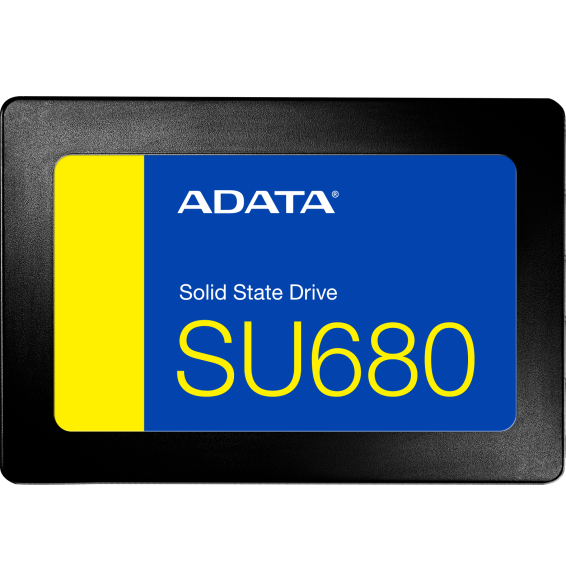
ADATA Ultimate SU680 2.5-inch SATA SSD with 3D NAND to give new life to a desktop or laptop PC: up to 520 MB/s read and 450 MB/s write, SLC cache, 240 GB to 1 TB depending on the version.
Silent and free of vibration, it withstands 1,500 G shocks over 0.5 ms and runs from 0 to 70 °C. Read up to 520 MB/s, write up to 450 MB/s, with an SLC cache and ECC error correction to hold the pace.