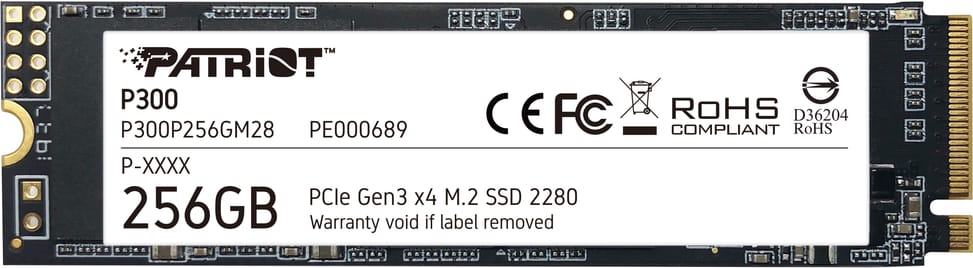
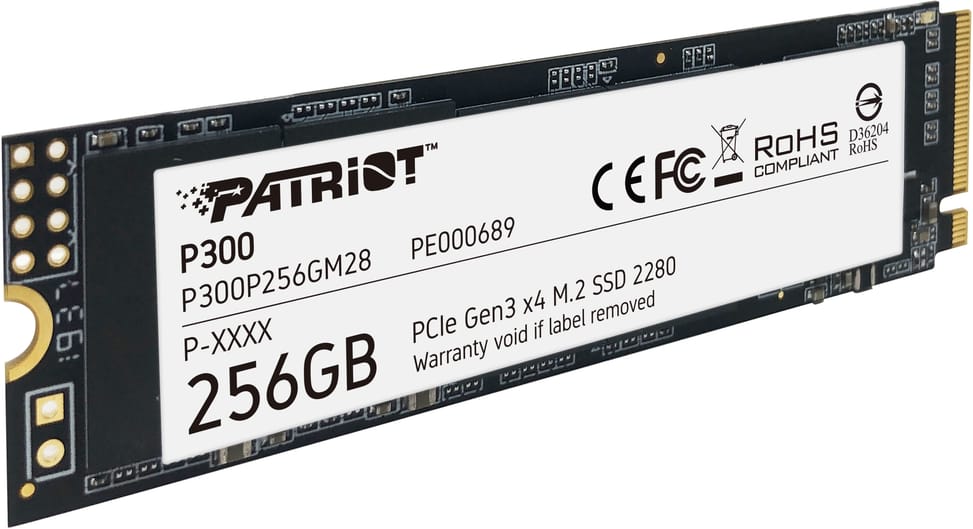
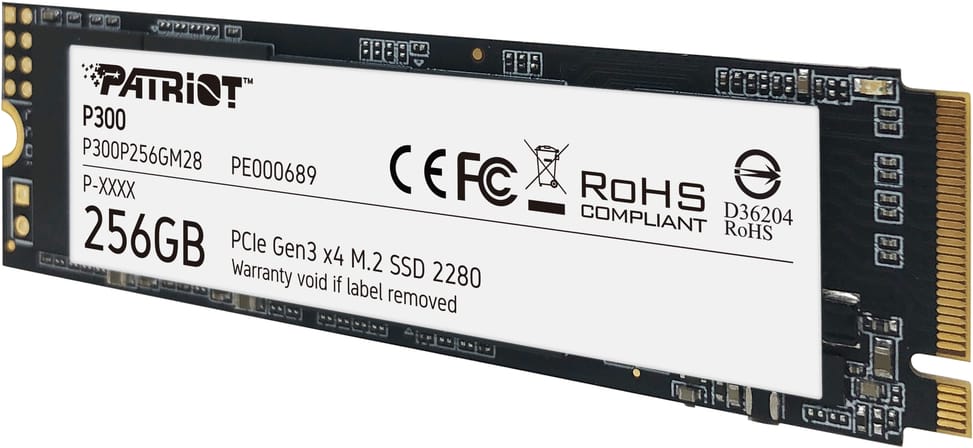
End-to-end data protection and SmartECC error correction, for 1,700 MB/s read and 1,100 MB/s write. Low power draw: the battery life of the laptop is preserved.
Patriot P300 256 GB SSD, M.2 2280, PCIe Gen3 x4 NVMe: an ultra-slim form factor that is ideal for ultrabooks — its small footprint and controlled power draw free up space and battery life. Compatibility: M.2 2280 form factor, PCIe Gen3 x4 NVMe 1.3 interface, fits any recent desktop or laptop, compatible with Windows 7/8/8.1/10/11. Technology: advanced firmware with SmartECC, NANDXtend ECC, end-to-end data protection, thermal management (thermal throttling) and HMB cache for smooth performance. Performance: sequential reads up to 1,700 MB/s, writes up to 1,100 MB/s. Endurance: TBW 120 TB, MTBF 1,500,000 h. Ideal for fitting out an ultrabook, upgrading a laptop, speeding up an office PC or creating a fast system drive alongside a storage HDD. The step up to NVMe in a light, discreet form factor.
Be the first to review this product and help other customers.
Write a review
Frequently asked questions about this product
What speeds are quoted for the 256 GB version of the P300?
1,700 MB/s read and 1,100 MB/s write sequential, on a PCIe Gen3 x4 interface compliant with the NVMe 1.3 standard. Patriot quotes 25% more throughput and IOPS than a conventional PCIe 3 x2 drive, which uses only two lanes instead of four.
How does this SSD protect data integrity?
Through two complementary mechanisms: end-to-end protection of the data path, which checks that data read back is exactly what was written, and SmartECC technology, which corrects read errors. The firmware also handles wear levelling.
Does this SSD have its own cache memory?
It relies on an HMB cache: rather than an on-board cache chip, it borrows a small portion of the PC's RAM to hold its mapping table. This is what makes such a thin drive possible, 3.8 mm thick and weighing 9 g, at 80 by 22 mm.
How many terabytes of writes can this 256 GB drive handle?
120 TB, or nearly five hundred full drive writes. The rated mean time between failures is 1,500,000 hours. That is a very generous margin for an office PC or a work laptop.
Which operating systems does this SSD support?
Windows 7, 8.0, 8.1, 10 and 11. On Windows 7 and 8.0, a driver may be needed, depending on the configuration, before the drive is recognised — something to plan for if you intend to boot directly from it on an older computer.
Does this SSD slow down when it gets hot?
It has active thermal management that temporarily reduces its speed if the temperature rises, rather than risk overheating. Its operating range is 0 to 70 °C, and its low power consumption helps preserve a laptop's battery life.
Is the drive new and under warranty?
It is new and your invoice serves as the warranty document. Its part number is P300P256GM28, to be quoted for any return. The full datasheet lists all the figures for this capacity.
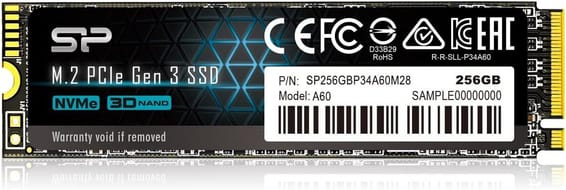
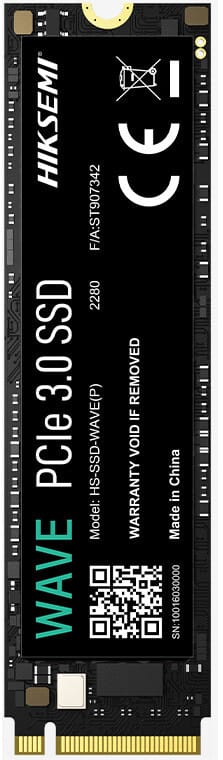
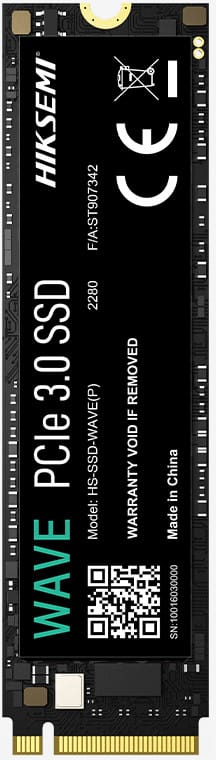
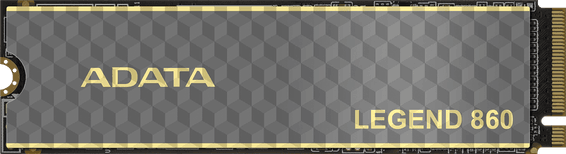
A host memory buffer (HMB) and an SLC cache take read speed to 2,200 MB/s and write speed to 1,600 MB/s. LDPC error correction, end-to-end data protection and the SP Toolbox utility to monitor drive health.
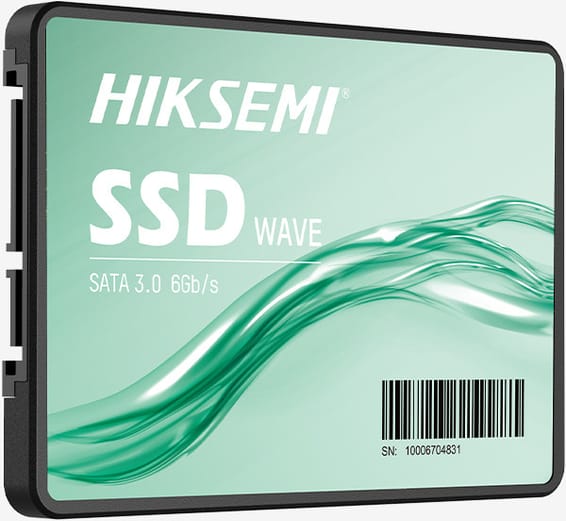
550 MB/s in sequential read, more than five times the speed of a spinning drive: noticeably quicker start-ups and application loading. No moving parts, so operation is silent and insensitive to knocks.
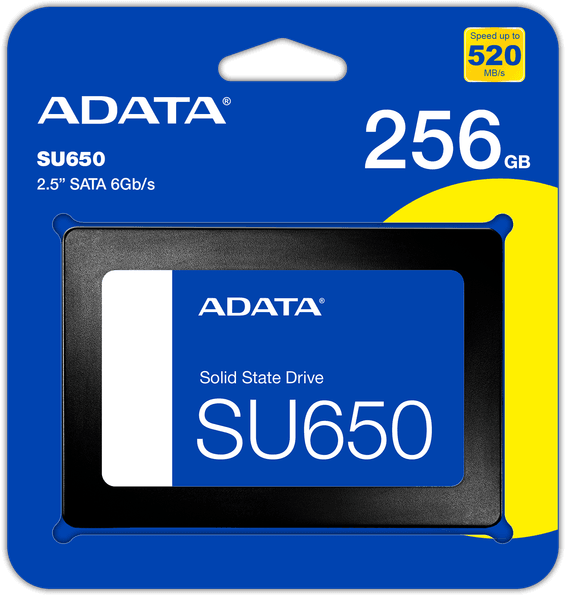
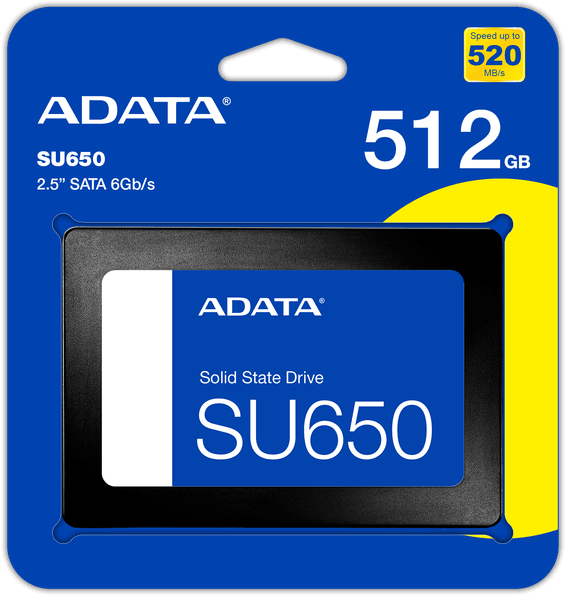
520 MB/s reading and 450 MB/s writing to replace a spinning hard drive with no noise and no vibration. 3D NAND memory, SLC cache and ECC error correction; the ADATA migration utility copies the whole system onto the new drive.
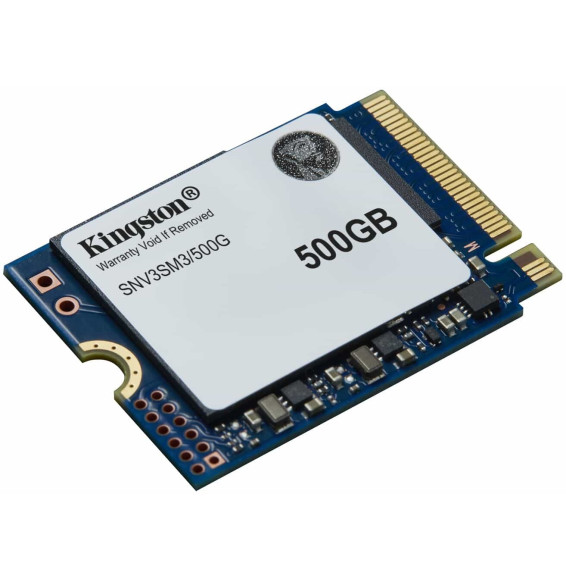
Short enough to fit an ultra-thin laptop or a handheld games console, and it weighs only 2.6 g. 5,000 MB/s read, 3,000 MB/s write, low power draw and 160 TB written of endurance.
Ten times faster than a spinning drive: 500 MB/s read, 350 MB/s write, enough to wake up a machine that drags at start-up. With no moving parts, it takes the knocks and vibration of a computer on the move.
Compatible with a desktop PC, a laptop and a PS4 alike, it reads at 530 MB/s and writes at 400 MB/s. 3D NAND memory with no moving parts, for an office machine that is finally responsive.
256-bit AES hardware encryption, TCG Opal and Microsoft eDrive: the data stays unreadable to anyone who gets hold of the machine. 550 MB/s read, 520 MB/s write over SATA 6 Gb/s.
Write up to 450 MB/s and read up to 500 MB/s: file copies and installations are far brisker than with a spinning drive. Silent, frugal with power and unaffected by vibration, in a tower or a laptop.
280 TB written endurance, 3D NAND memory and ECC correction: a second drive built to last. Read up to 520 MB/s and write up to 450 MB/s, with no noise or vibration, in a desktop PC or a laptop.
A host memory buffer (HMB) and an SLC cache take read speed to 2,200 MB/s and write speed to 1,600 MB/s. LDPC error correction, end-to-end data protection and the SP Toolbox utility to monitor drive health.
2,500 MB/s read and 1,025 MB/s write, with no moving parts at all: the shock- and drop-resistant design protects the data. 3D NAND memory and TRIM command support to hold the speeds over time.
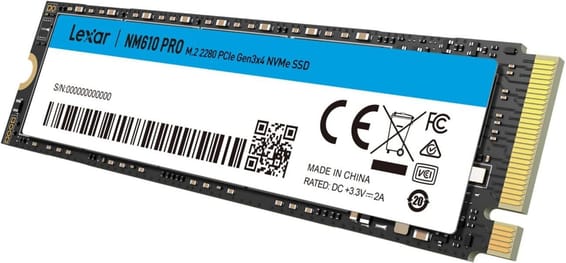
Around six times the speed of a SATA model: 3,300 MB/s claimed in read, for instant start-ups and application launches. 240 TB written endurance and a design with no moving parts, resistant to shocks.
520 MB/s reading and 450 MB/s writing to replace a spinning hard drive with no noise and no vibration. 3D NAND memory, SLC cache and ECC error correction; the ADATA migration utility copies the whole system onto the new drive.
Ten times faster than a spinning drive: 500 MB/s read, 350 MB/s write, enough to wake up a machine that drags at start-up. With no moving parts, it takes the knocks and vibration of a computer on the move.
Compatible with a desktop PC, a laptop and a PS4 alike, it reads at 530 MB/s and writes at 400 MB/s. 3D NAND memory with no moving parts, for an office machine that is finally responsive.
Simple upgrade for a laptop or a tower: 5,000 MB/s read and 3,000 MB/s write, host memory buffer and SLC cache. 160 TB written of endurance and PlayStation 5 compatibility.
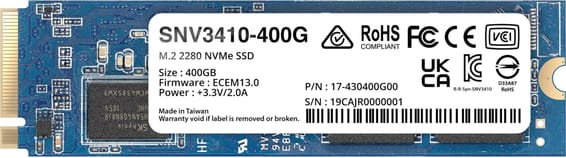
Designed to run 24/7, it takes an array's cache to 3,000 MB/s read and 750 MB/s write. 491 TB written of endurance, end-to-end data protection and wear monitoring straight in DSM.