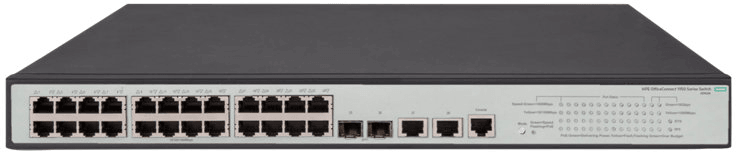
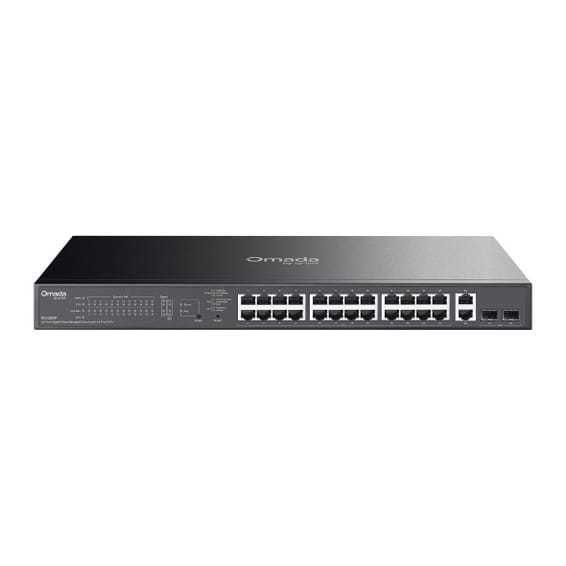
PoE+ (802.3at standard, 370 W budget) on all the Gigabit ports, with 4 uplinks at 10 Gbps: 2 SFP+ fibre and 2 10GBASE-T copper. Stackable up to 4 units, intuitive web interface over HTTPS/SSL.
PoE+ 802.3at standard, total budget 370 W
Intuitive web administration over HTTPS/SSL
2 SFP+ ports at 10 Gbps (fibre)
2 10GBASE-T ports at 10 Gbps (copper)
Stackable up to 4 units (true stacking)
VLANs (4094), access control lists and 802.1X/RADIUS
Get more from your network with the HPE OfficeConnect 1950 24G 2SFP+ 2XGT PoE+ switch. Equipped with 24 × 1GbE PoE+ ports, 2 SFP+ ports and 2 × 10GbE ports, this switch delivers fast, reliable connectivity for demanding business environments. Enjoy outstanding performance and simpler management thanks to advanced features such as quality of service (QoS) and enhanced security. Ideal for boosting the productivity and reliability of your network, it handles data efficiently and gives you the flexibility to meet your business's growing needs.
Be the first to review this product and help other customers.
Write a review
Frequently asked questions about this product
What connectivity does the HPE OfficeConnect 1950 24G PoE+ offer?
24 Gigabit PoE+ ports, 2 10 Gbps SFP+ ports for fibre and 2 10GBASE-T ports for copper. These last two uplinks accept Category 6A cable, which is less expensive than fibre over short distances.
What PoE budget does this switch offer?
370 W in total, up to 30 W per port with PoE+ 802.3at. The switch remains compatible with the older 802.3af standard, which is capped at 15.4 W: IP phones, Wi-Fi access points and cameras of both generations coexist with no configuration needed.
Can the PoE budget be increased or the power supply made more resilient?
Yes, with the optional HPE RPS1600 redundant power system (JG136A). It raises the PoE budget to 740 W and keeps the switch and powered devices running if the internal power supply fails.
Can several HPE 1950 switches be stacked?
Yes, with true stacking of up to 4 units, managed as a single logical device. Stacking uses Cat 6A cable, fibre for longer distances or DAC cable, and the units can be physically apart.
How is this switch managed?
Through a web interface encrypted with HTTPS and SSL, designed to be usable without training. A limited command line helps with initial deployment and troubleshooting, and SNMP v1, v2c and v3 provide remote monitoring.
What happens if no DHCP server is present at startup?
The switch falls back to a unique fixed address, derived from its MAC address. Connected to a network with a DHCP server, on the other hand, it obtains its address automatically: either way, it remains reachable without intervention.
How can a suspect cable be diagnosed from the switch?
With the built-in cable diagnostics tool, which remotely detects faults on connected links. Port mirroring can also send a port's traffic to an analyser, and RMON reports statistics, history and alarms.
What security protections does this switch apply?
Access control lists by MAC or IP address, with time ranges, 802.1X and RADIUS authentication, automatic VLAN assignment based on identity, port isolation and protection against ARP attacks.
How does quality of service classify traffic?
It recognises 802.1p and DSCP tags and distributes packets across four hardware queues, using strict priority, weighted round robin or a combination of both. Rate limiting and broadcast control round out the set.
Does this switch perform routing and support IPv6?
Yes: Layer 2 switching and Layer 3 static routing, over IPv4 as well as IPv6. On top of that come MLD snooping for IPv6 multicast, and access control lists and quality of service applied to IPv6 traffic.
Does the switch support jumbo frames?
Yes, up to 10 KB. On 10 Gbps links to a server or storage, these large frames reduce the load on processors and improve real-world throughput. Packet storm protection remains adjustable by threshold.
Is the switch new and covered by a warranty?
Yes, new equipment, with the invoice serving as the warranty document. It can be installed in a 19-inch rack or on a desk, and the 1950 series documentation details all its features.
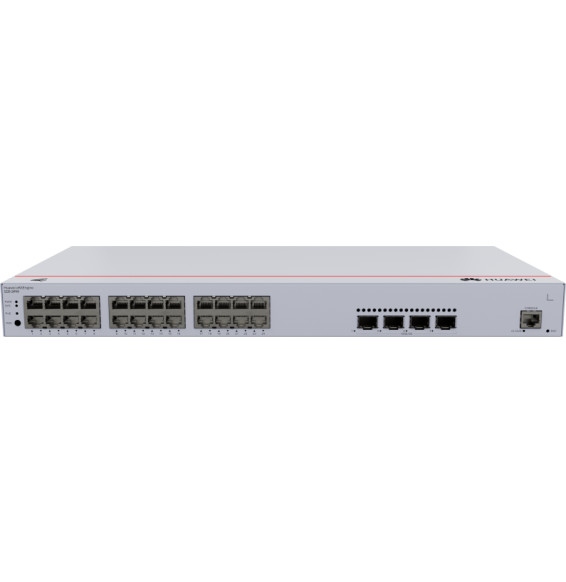
Managed switch that keeps your PoE equipment powered even during a restart (perpetual PoE), for continuity of service on critical cameras or Wi-Fi access points. Configurable through the HUAWEI eKit App cloud or locally.
•24 Gigabit PoE+ RJ45 ports
•2 SFP+ ports at 10 Gbps and 2 SFP ports at 2.5 Gbps for the uplink
•Fast and perpetual PoE — power kept up during restarts
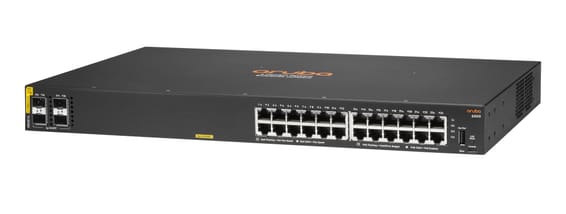
Managed access switch designed for SMEs and branch offices: powers workstations, Wi-Fi access points and IP cameras over Power over Ethernet, with centralised control from Aruba Central and automated deployment.
•Managed via Aruba Central (cloud or on-premise), web GUI, CLI and REST API
•PoE+ up to 30 W per port (IEEE 802.3af/at, class 4)
Fast PoE instantly powers cameras, Wi-Fi access points and IP phones over the network cable, with no break on restart. Four 10G links absorb traffic to the network core. Web, cloud app or command line control, built-in DoS/802.1X security.
Managed switch that powers its ports over PoE+ through the network cable, with two 2.5 Gbps combo ports for recent Wi-Fi access points. Configurable through the HUAWEI eKit App cloud or locally.
Managed switch that powers up to 24 devices (cameras, Wi-Fi access points, IP phones) over the network cable, with a 400 W PoE+ budget. Uplinks at 2.5 Gbps for recent access points.
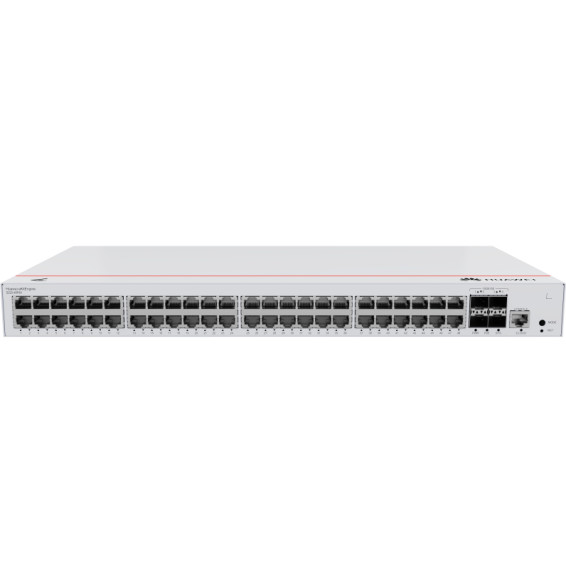
Covers a whole floor of cameras, Wi-Fi access points and IP phones on a single device, without multiplying power units. 10G links and a capacity of 176 Gbps absorb the combined traffic. VLANs, security and administration of enterprise equipment.
Designed for SMEs and video surveillance: automatic IP camera recognition, loop prevention and remote port restart through Ruijie Cloud. Extension up to 250 m in camera mode.