How many cameras can I actually power with the 384 W PoE budget?
The 384 W budget is shared across the 24 PoE+ ports, with a cap of 30 W per port: think in watts consumed, not in number of devices. A fixed camera draws far less than a PTZ camera or a Wi-Fi access point, and this budget comes from laboratory tests — keep a margin.
Can you really power a camera located 250 metres from the switch?
Yes, but with a deliberate trade-off: over this distance, the port concerned drops to 10 Mbps. That is workable for a compressed video surveillance stream, not for file transfers, and the actual range depends on the quality of the cable installed.
What happens to the cameras when the switch restarts?
They stay powered: the Fast PoE and Perpetual PoE features provide continuous power, even while the switch restarts. An update therefore does not interrupt video surveillance.
Can a frozen camera be restarted without going on site?
Yes, by cutting and then restoring its PoE power. In standalone mode, this PoE recovery is automatic; when the switch is managed by an Omada controller, the restart is done manually from the interface. That is as many site visits saved.
Do you necessarily need an Omada controller to use this switch?
No. It works plug-and-play and is configured from its web interface. The Omada controller — hardware, software or cloud — adds automatic device discovery, configuration and firmware updates in batches; Zero-Touch provisioning, for its part, requires the cloud controller.
Can it be installed in an occupied office?
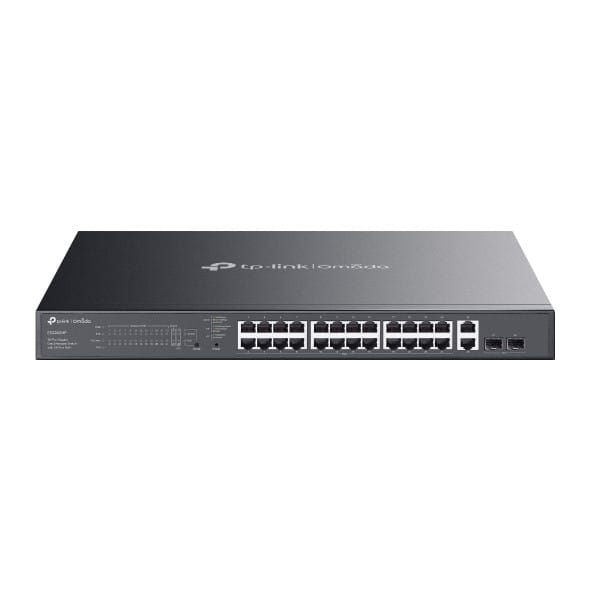
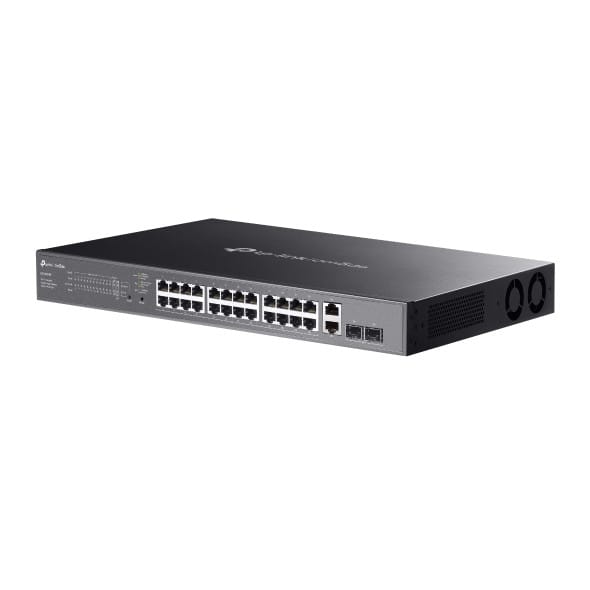
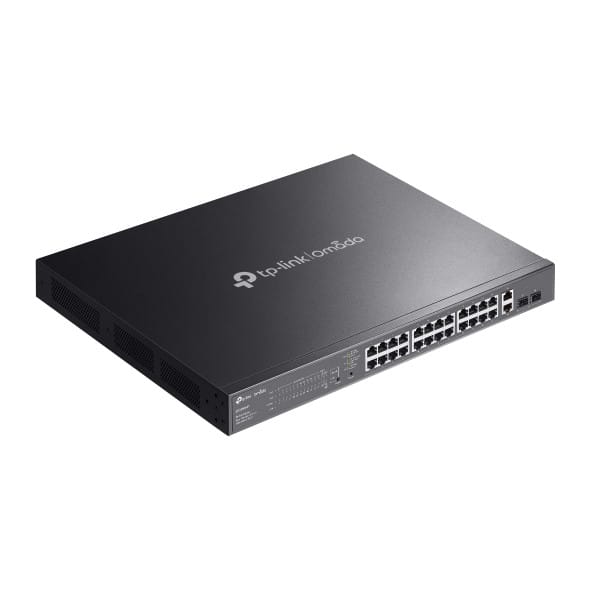
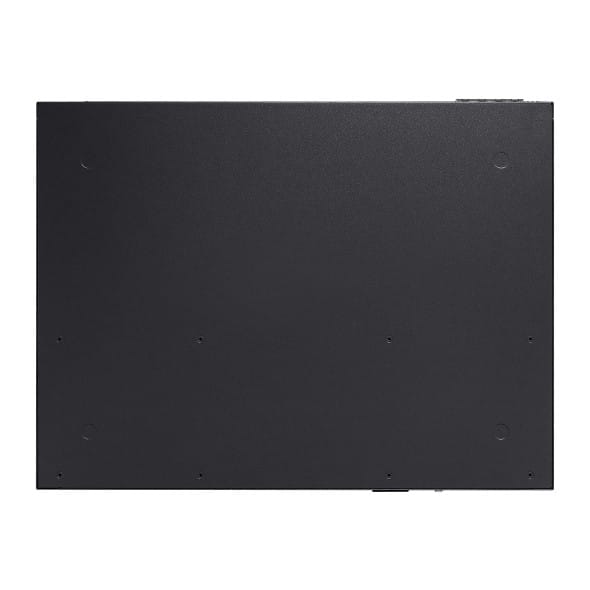
Best avoided: it has two fans and produces 36.9 to 46.2 dBA at one metre. Its place is in a rack or a technical room — the 440 × 330 × 44 mm metal chassis, weighing 5 kg, mounts in a 19-inch rack, while desktop placement remains possible.
How much power should you plan for on the UPS and the room's air conditioning?
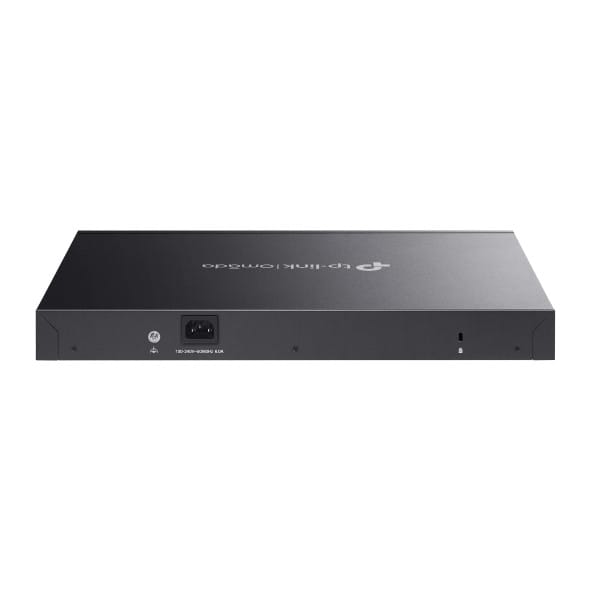
Allow 454.8 W maximum, PoE included (384 W delivered), compared with only 17.2 W at idle; the power supply accepts 100-240 V. On the thermal side, it dissipates up to 1,546 BTU/h at full load, a figure to include in the air-conditioning calculation for the rack.
How many VLANs can you create on this switch?
Up to 32 802.1Q VLAN groups. On top of that come port-based VLANs, MTU VLAN and above all port isolation, which stops two cameras from seeing each other while still letting traffic through to the recorder.
Can several ports be aggregated towards the server or the recorder?
Yes, with static link aggregation: up to 4 groups of up to 8 ports each. Enough to multiply the bandwidth towards an NVR or a file server, with the switch's switching capacity reaching 56 Gbps at 41.66 Mpps.
How do you connect this switch to another building over fibre optic?
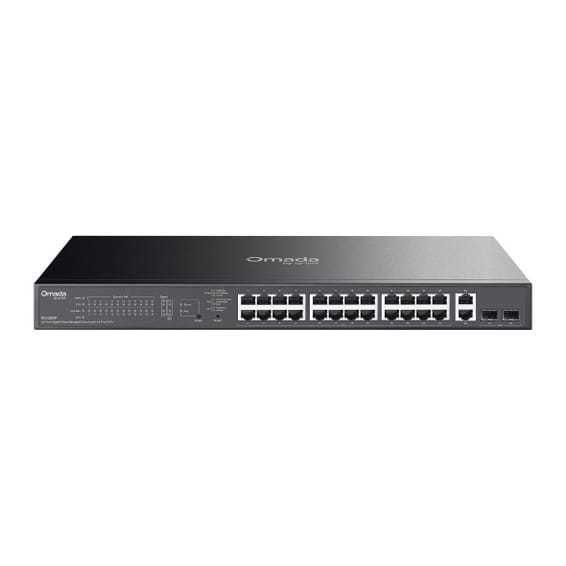
Through the 2 Gigabit SFP slots, designed for fibre links. The 2 non-PoE Gigabit RJ45 ports remain available for a copper link to the router or another switch: the 24 PoE+ ports thus stay entirely dedicated to powered devices.
How do you find a faulty cable without climbing a ladder?
The web interface includes cable diagnostics, complemented by per-port traffic statistics and port mirroring to analyse a suspect link. Loop detection and automatic loop prevention, for their part, deal with a cable looped back by mistake.
Is it suitable for a video surveillance network with multicast streams?
Yes. IGMP Snooping v1/v2/v3 filters the distribution of multicast streams, storm control limits unwanted broadcasts and QoS with 8 priority queues lets video go ahead of other traffic. The MAC address table holds 8,000 entries.
What makes it reliable in a network rack?
±6 kV common-mode surge protection on the Ethernet ports, ±8 kV (air) and ±4 kV (contact) ESD protection, an MTBF of 224,143 hours at 25 °C and an operating range of -5 to 45 °C. It is CE, FCC and RoHS certified.
Is this TP-Link ES228GMP switch new and under warranty?
Yes:
new, supplied with its invoice, which serves as the
1-year warranty document. Details of the L2, VLAN, QoS and PoE features can be found in the
datasheet (PDF).