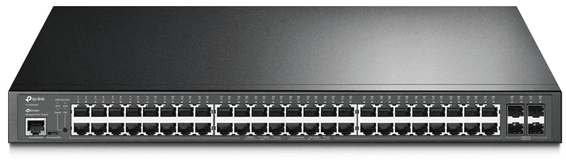
How are the 370 W of PoE+ on the RG-ES228GS-P shared?
370 W shared by the 24 PoE+ ports, each compliant with the 802.3af and 802.3at standards. Twenty-four cameras at 12 W draw less than 300 W, whereas around fifteen power-hungry Wi-Fi access points use up the whole budget. With no PoE load, the switch draws less than 25 W; at full load, less than 400 W.
Are all the ports on this 28-port model powered?
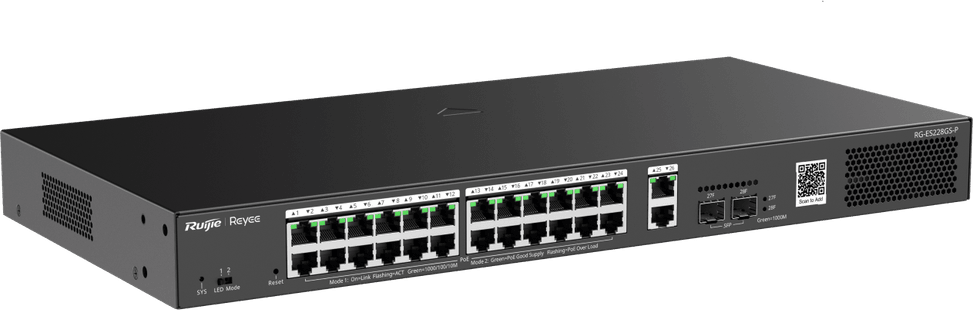
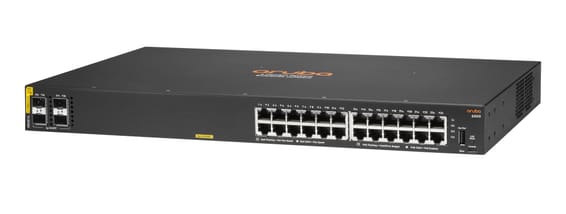
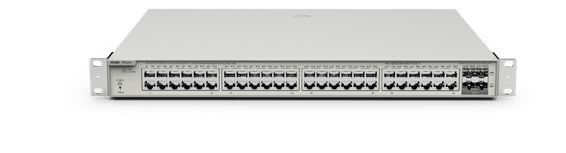
No: 24 PoE+ ports out of 26 copper ports. The last two Gigabit RJ45 ports carry data only, and two 1G SFP slots complete the front panel for the fibre uplink. Keep this in mind when allocating cameras and links.
How many VLANs can actually be created on this switch?
Sixteen at most, chosen from the ID range 1 to 4094. The distinction is essential when drawing up the addressing plan: the range is complete, but the number of VLANs active at the same time stops at sixteen. Beyond that, you need to move up to a higher range.
Is the local web interface accessible over HTTPS?
Local management is done over HTTP. Restrict it to a workstation on the management network, and manage the switch remotely via Ruijie Cloud or the Reyee app, which also handle zero-touch provisioning and monitoring. Web authentication protects access.
What happens if a powered camera stops responding?
The PoE watchdog power-cycles the port to restart the device, and a PoE power alarm flags abnormal consumption. Camera detection, for its part, identifies the video surveillance devices connected, which saves you from working out which port carries what.
How does the switch react to a cabling loop?
Loop prevention isolates the faulty port to protect the rest of the network. Broadcast, multicast and unknown unicast control limits bursts at the same time, and port isolation separates devices that have no need to see each other.
Is this rack-mount switch noisy in a shared room?
The noise level stays below 40 dB during operation, with fan speed control. Airflow runs front to back and left to back: leave that clearance in the rack cabinet. The chassis handles 0 to 40 °C and altitudes of up to 5,000 m.
What electrical protection does this switch offer?
The power port is protected against surges up to 6 kV, in both common mode and differential mode, and the network ports up to 4 kV in common mode. ESD protection reaches 8 kV air discharge and 6 kV contact discharge — useful where outdoor cameras are cabled into the building.
How far does a link reach in camera mode on this model?
Up to 250 m, well beyond the 100 metres of an ordinary Ethernet link: a distant camera can be connected without an intermediate enclosure. Actual range depends on the cabling and the scenario, and the mode is set port by port from the interface.
What internal performance does this 28-port chassis deliver?
56 Gbps switching capacity and 41.664 Mpps, with an 8,000-entry MAC address table, a 4.1 Mbit buffer and 8 MB of flash memory. Jumbo frames go up to 10,000 bytes, and per-port rate limiting works on both ingress and egress.
How much rack space does this switch take up?
440 × 214.9 × 44 mm, i.e. 1U in 19-inch format, for 2.84 kg net. The case is metal, the built-in power supply accepts 100 to 240 V at 50/60 Hz, 6 A, and the cables can be hot-swapped without switching the switch off.
Is the switch new, and where can I view its specifications?
Yes, new equipment, with the invoice serving as the warranty document. The manufacturer's document covers the entire RG-ES200 series, with the capacities, PoE budgets and environmental conditions of each model:
datasheet (PDF).