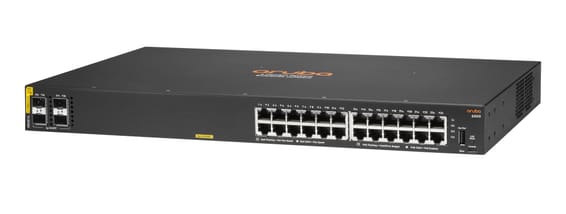
Aruba CX access switch built on the Gen7 ASIC: stackable up to 8 units via VSF to form a 384-port stack, with Aruba Central cloud administration designed for large enterprise infrastructures.
L2/L3 on the Aruba Gen7 ASIC, very low latency
Class 4 PoE, up to 30 W per port (IEEE 802.3af/at)
Stackable up to 8 switches via VSF (384 unified logical ports)
Aruba Central and NetEdit cloud management, Aruba CX mobile app
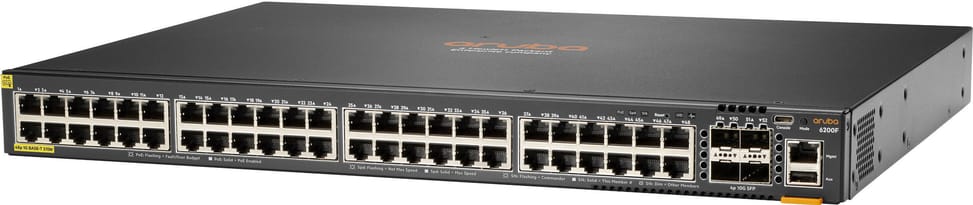
The HPE Aruba CX 6200F 48G PoE+ 370W 4SFP+ is a high-density L2/L3 managed switch, built on Aruba's Gen7 ASIC, for large enterprise infrastructures combining large-scale PoE deployment with 10 Gigabit uplinks. 48 Class 4 PoE Gigabit RJ45 ports: each port delivers up to 30 W (IEEE 802.3af/at), with a total budget of 370 W to power Wi-Fi 6 access points, high-definition IP cameras and VoIP phones simultaneously at scale. 4 × 100M/1/10 GbE SFP+ ports for very high-speed fibre uplinks. Stackable up to 8 members with VSF (384 unified logical ports); cloud management through Aruba Central and NetEdit: OSPF, ACL, QoS, dynamic segmentation. 176 Gbps switching capacity, 130.9 Mpps throughput. 1U rack-mountable format. Ref. JL727B.
Be the first to review this product and help other customers.
Write a review
Frequently asked questions about this product
Can several CX 6200F switches be stacked so that you manage just one device?
Yes, up to eight members with VSF stacking, which uses the built-in SFP+ ports: the stack reaches 384 ports managed as a single switch. Members can be spread across several cabinets, which simplifies cabling in a building.
How are the 370 W of PoE shared across the 48 ports?
370 W shared across the 48 ports in Class 4, up to 30 W per port, to the 802.3af and 802.3at standards. Around thirty cameras at 12 W already use up most of the budget: it is the budget, not the number of ports, that limits a dense deployment.
What uplinks does the CX 6200F 48G offer?
Four 100M/1/10G SFP+ ports: they accept a 10 Gigabit module as well as a slower one, and are also used to build the VSF stack. Switching capacity reaches 176 Gbps at 130.9 Mpps, on Aruba's Gen7 ASIC.
Does this switch encrypt traffic on the uplinks?
Yes, it supports MACsec 256 on the uplinks, as well as LRM modules. Traffic between two buildings connected by fibre can therefore be encrypted at link level, with no additional device in the path.
Can the CX 6200F route between several subnets?
Yes, up to OSPF: it is a Layer 3 switch, capable of inter-VLAN routing and dynamic protocols, with associated access control lists and quality of service. Segmentation therefore no longer cuts off communication between departments.
How can you regain control of this switch without going through the network?
Three physical access points: an RJ-45 console port, a USB-C console port and a dedicated out-of-band management port, plus a USB Type-A host port for a USB flash drive carrying a configuration or firmware file.
Can the configuration of this switch be automated?
Yes, through Python agents running on the switch and through REST APIs: repetitive tasks and security checks are scripted instead of being entered by hand. NetEdit also lets you apply a validated change across a whole fleet of devices.
How do you monitor this switch day to day?
From Aruba Central, in the cloud, with a single view of the whole fleet, from NetEdit for bulk changes, or from the Aruba CX mobile app for a quick intervention in the equipment room. The web interface and the command line remain available locally.
Is this 48-port PoE model suited to a large infrastructure?
That is what it is designed for: 48 Class 4 PoE ports and 176 Gbps of capacity, on the Gen7 ASIC built for very low latency, with stacking up to 384 ports. The form factor remains a 1U rack-mountable chassis, to be installed in a rack with enough clearance for ventilation.
Is the switch new, and where can I view its datasheet?
Yes, new equipment, with the invoice serving as the warranty document. The manufacturer's document details the CX 6200F 48G Class 4 PoE, its ports, its VSF stacking and its security features: datasheet (PDF).
Powers a whole floor over one cable with 10 Gbps uplinks to the network core: 370 W of PoE+ across the 48 Gigabit ports, layer 3 routing and centralised management from Aruba Central.
•PoE+ (802.3at) on all 48 ports, total budget 370 W
•Up to 30 W per port — Wi-Fi access points, IP cameras, IP phones
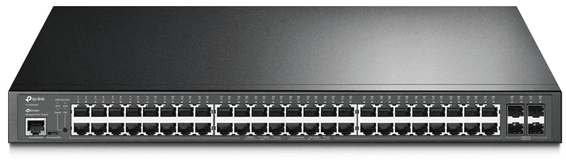
Total PoE+ budget of 384 W to power a large number of cameras, Wi-Fi access points and IP phones. 104 Gbps switching capacity, driven from the Omada SDN cloud.
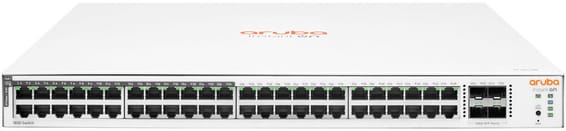
48 Gigabit ports, half of them PoE+ (ports 1 to 24), for mixed SME or campus deployments — simplified control from the Aruba Instant On app, with no subscription.
•24 of the 48 ports in PoE+ (802.3at), ports 1 to 24
Covers a whole floor of cameras, Wi-Fi access points and IP phones on a single device, without multiplying power units. 10G links and a capacity of 176 Gbps absorb the combined traffic. VLANs, security and administration of enterprise equipment.
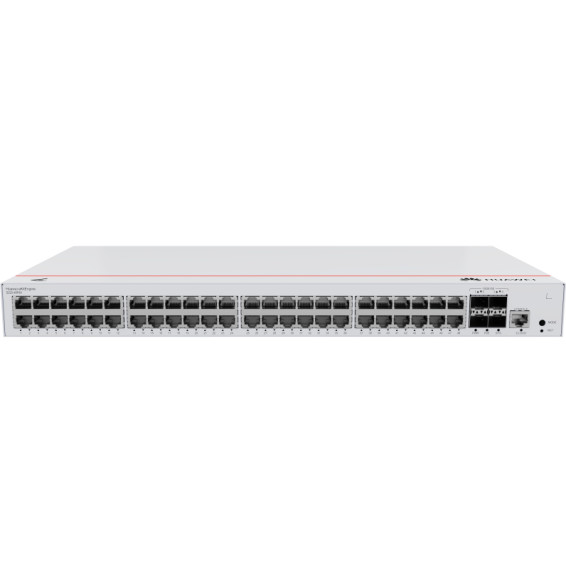
Managed access switch designed for SMEs and branch offices: powers workstations, Wi-Fi access points and IP cameras over Power over Ethernet, with centralised control from Aruba Central and automated deployment.
•Managed via Aruba Central (cloud or on-premise), web GUI, CLI and REST API
•PoE+ up to 30 W per port (IEEE 802.3af/at, class 4)
Fast PoE instantly powers cameras, Wi-Fi access points and IP phones over the network cable, with no break on restart. Four 10G links absorb traffic to the network core. Web, cloud app or command line control, built-in DoS/802.1X security.
Designed for SMEs and video surveillance, in a 19″ rackable format: automatic IP camera recognition, PoE consumption alarm and remote port restart through Ruijie Cloud.