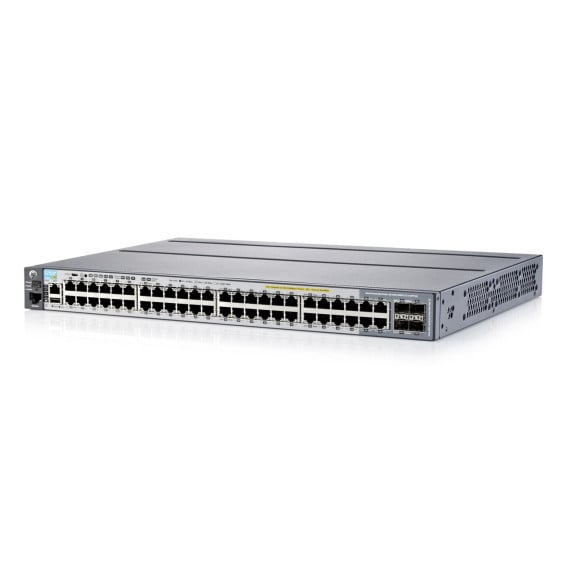
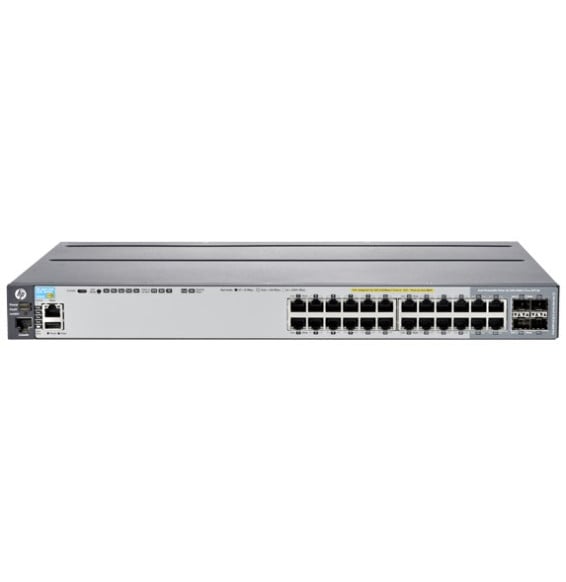
How should the 370 W of PoE+ be shared across 48 ports?
370 W shared by all 48 ports, with a maximum of 30 W per port under 802.3at. The budget fills up quickly: thirty cameras at 12 W use almost all of it, and a dozen high-power Wi-Fi access points are enough to do the same. The limit is not the number of ports, it is the power budget.
Can this switch route between several subnets?
Yes, it is a Layer 3 model: static routing — 256 routes —, RIP v1, v2 and RIPng, and Access OSPF in OSPFv2 and OSPFv3. Segmenting the network into VLANs therefore no longer cuts communication between departments, and the traffic does not have to go all the way up to the router.
What are the OSPF limits on a 2930F?
A single OSPF area and eight interfaces at most. This is access-level OSPF, designed to connect a building to a network core, not to carry the routed topology of an entire campus. Beyond that, routing has to be handled further up, by an aggregation device.
Can several 2930F switches be managed as a single device?
Yes, up to eight switches with front-panel VSF stacking: the stack is managed as a single chassis, in a ring topology that survives the failure of one member. A link aggregation group can also use ports spread across several members of the stack.
How many VLANs can this model handle simultaneously?
2,000 active VLANs, with IDs taken from the full 802.1Q range of 4,094 values. RPVST+ builds one spanning tree per VLAN to make better use of redundant links, and private VLANs isolate workstations within the same segment.
What happens when an Aruba access point is connected to a port?
The switch detects it and applies the associated settings automatically: VLAN, class of service, maximum PoE power and PoE priority. The port therefore configures itself for an access point, which reduces errors when rolling out Wi-Fi across an entire floor.
Can you regain control of the switch when the network is down?
Yes, through out-of-band management: an RS-232C serial port or a micro-USB port gives access to the console. In-band, the choice remains wide — web interface, command line, Telnet, SNMP, RMON1, FTP, and the Aruba Central, AirWave or HPE IMC platforms.
How much buffer memory does this switch dedicate to traffic peaks?
12.38 MB, split into 4.5 MB ingress and 7.875 MB egress, with 1 GB of DDR3 SDRAM, 4 GB of eMMC memory and a dual-core Arm Cortex A9 processor at 1,016 MHz. This sizing absorbs bursts without dropping packets across an entire floor.
How much electrical power should you plan for this chassis?
459 W at most, including the 370 W of PoE, on a 100-127 or 200-240 V input. Size the UPS accordingly. The chassis measures 442.5 × 304.2 × 43.9 mm and weighs 4.46 kg: 1U high, but more than 30 cm deep, so check before sliding it into a cabinet.
What uplinks does this 48-port model offer?
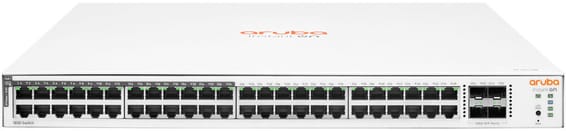
Four 1/10 GbE SFP+ slots, with no intermediate PHY layer: the uplink to the network core runs at 10 Gbps over fibre, or at Gigabit with a 1G module. The 176 Gbps switching capacity and 112 Mpps throughput keep up with no bottleneck.
What security features does this switch provide?
802.1X authentication, local MAC authentication with automatic VLAN assignment, access control lists, port security, RADIUS and TACACS+, SNMPv3 and IPv4/IPv6 dual stack. Dynamic segmentation can also send a user's traffic through a tunnel to an Aruba controller.
Is the switch new, and where can I find its datasheet?
Yes, new equipment, with the invoice serving as the warranty document. The manufacturer's document details the 2930F series, its routing, its VSF stacking and its security features:
PDF datasheet.