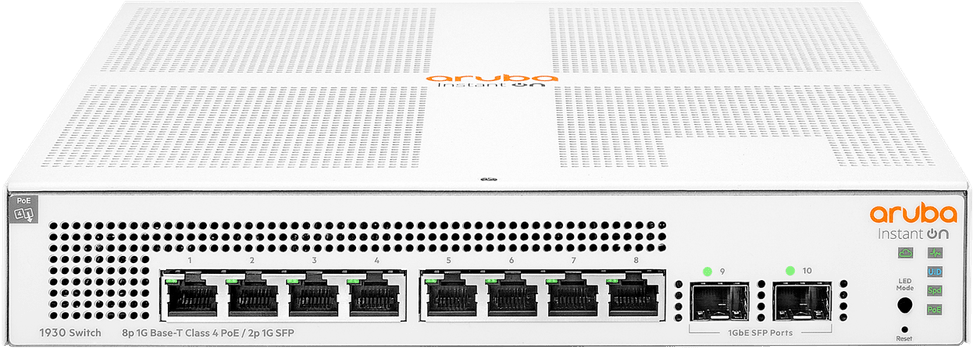
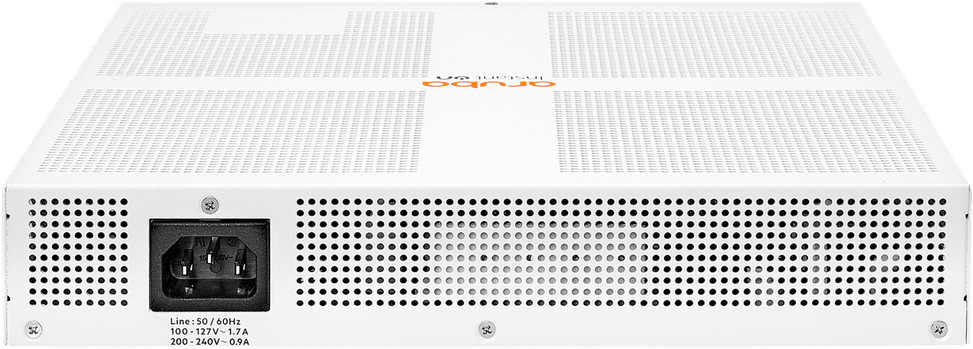
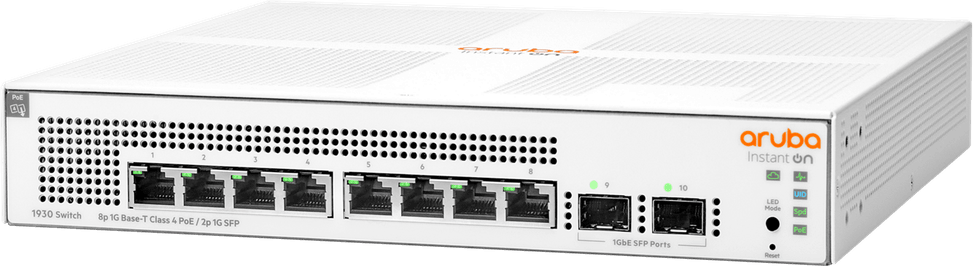
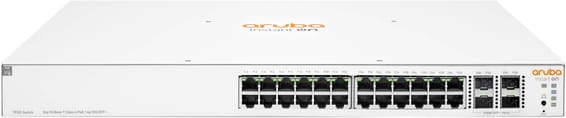
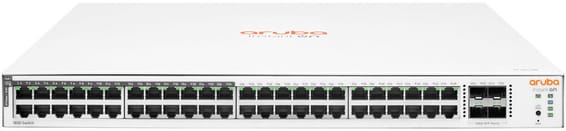
Aruba Instant On 1930 8-port PoE+ managed switch, ideal for small offices that need silent power delivery to every device. Connectivity: 8 10/100/1000BASE-T RJ45 PoE+ ports + 2 1G SFP fibre uplink ports — fanless design (zero decibels), silent in any environment. PoE+:124 W budget (IEEE 802.3af/at, Class 4), up to 30 W per port for IP phones, cameras and Wi-Fi access points. Performance:20 Gbps non-blocking switching capacity, throughput 14.88 Mpps, 8,000-entry MAC table. L2+ management: via the Aruba Instant On app (mobile) and web portal — VLANs, QoS, port security, IPv4 static routing, PoE monitoring. 802.3ad LACP, STP/RSTP, IGMP snooping, 802.1X access control, RADIUS. Compact desktop or 19" rack form factor; fanless, no software subscription required.
Be the first to review this product and help other customers.
Write a review
Frequently asked questions about this product
How many 30 W devices can the 124 W budget power?
Four, if each one really draws its full 30 W. The 124 W is shared across the 8 Class 4 PoE+ ports: eight IP phones at 7 W or eight fixed cameras at 12 W fit with room to spare, while four power-hungry Wi-Fi access points use it all. 802.3af devices at 15.4 W are supported in the same way.
What happens when the PoE budget is reached?
The switch automatically reserves the highest priority level — critical — for Instant On access points, which stay powered. Power allocation follows your choice of LLDP-MED, PoE class or actual consumption, which reclaims the watts a device does not use. A time schedule switches ports off outside business hours.
Is this PoE model noisy once installed in an office?
No: the 8-port models in the 1930 series are fanless, PoE models included — no noise at all, even placed in a meeting room. Allow for 150.2 W at the meter at peak, including the 124 W of PoE, and 11.7 W at idle. The unit measures 25.4 × 25.4 × 4.39 cm and weighs 1.16 kg.
How many virtual networks can the 1930 8G carry?
256 VLANs at most, with IDs taken from 2 to 4093: the range is wide, but the number of active VLANs stops at 256. A dedicated management VLAN protects access to the interface, and the auto voice VLAN recognises IP phones to prioritise their traffic without manual configuration.
Can two VLANs communicate without adding a router?
Yes: the 1930 handles static IPv4 routing, with each VLAN receiving its address manually or via DHCP, up to 32 static entries. That is the difference between a Layer 2+ switch and a basic model: segmenting the network no longer means sending all traffic up to the router.
Do the two SFP slots accept 10 Gbps modules?
No, they are Gigabit. In the 1930 series, only the 24- and 48-port models get 1G/10G SFP+ slots; the 8-port model has two 1G SFP slots, intended for a fibre uplink or for a distance copper cannot cover. The optical module is chosen according to the fibre already in place.
How do you reach the web interface at first power-up?
The switch boots as a DHCP client and takes the address provided by the router; with no DHCP server on the link, it falls back to the static address 192.168.1.1. Then put your laptop on the same subnet to open the local web interface, which allows up to five simultaneous HTTP or HTTPS sessions.
How many link aggregation groups does the 8-port model support?
Four, of up to eight ports each, using LACP or manual configuration. On an access switch, two ports aggregated towards the core switch are usually enough to remove the bottleneck, and the link survives the loss of a cable. 802.3x flow control limits losses on the congested side.
Can devices be authenticated before being given network access?
Yes, with 802.1X, with VLAN assignment by the RADIUS server or dynamic VLAN creation. The per-port allow list restricts access to selected addresses, DHCP snooping blocks untrusted servers, and dynamic ARP protection blocks broadcasts from unauthorised hosts.
How do you spot this switch in a rack and monitor its status?
A locator LED can be set to on, blinking or off from the app: the right unit stands out instantly among identical models. The Topology view and the site inventory show devices that have gone down, and port mirroring sends the traffic of a port or VLAN to an analyser.
Does the 1930 8G support jumbo frames and energy saving?
Yes to both. Frames go up to 9,216 bytes to speed up large transfers, and the 802.3az standard cuts power consumption during periods of low activity. Inactive ports are put to sleep and wake up as soon as a link is detected; the interface even displays an estimate of the energy saved.
Is the switch new, and where can I find its technical documentation?
Yes, new equipment, with the invoice serving as the warranty document. The manufacturer's document for the Instant On 1930 series, detailing the PoE, security, quality of service and routing features, is available here: PDF datasheet.
Each PoE+ port delivers up to 30 W, for a total budget of 120 W, rounded out by two fibre links. Managed from the GWN.Cloud platform or locally, with VLANs and advanced security.
•8 PoE+ ports (802.3af/at), total budget 120 W, up to 30 W per port
Compact layer 2 access switch for SMEs and video surveillance: automatic IP camera recognition, loop prevention and remote management through Ruijie Cloud. Silent, fanless operation.
Aruba Instant On switch for small businesses: full L2+ managed from the mobile app, the cloud portal or a local web interface, with a more measured PoE budget for flexible deployment of Wi-Fi access points and IP cameras.
Layer 2 Gigabit switch for SMEs, with PoE+ ports to power cameras and Wi-Fi access points, plus SFP fibre links. Silent rackable format, driven through UniFi Network.
Total PoE+ budget of 384 W to power a large number of cameras, Wi-Fi access points and IP phones. 104 Gbps switching capacity, driven from the Omada SDN cloud.
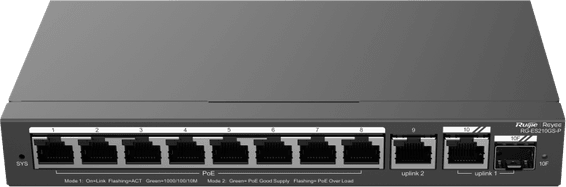
Compact PoE+ access switch (802.3af/at standard) to power IP cameras, Wi-Fi access points or VoIP phones in small spaces. Gigabit/SFP combo uplink, managed through Ruijie Cloud.
48 Gigabit ports, half of them PoE+ (ports 1 to 24), for mixed SME or campus deployments — simplified control from the Aruba Instant On app, with no subscription.
•24 of the 48 ports in PoE+ (802.3at), ports 1 to 24