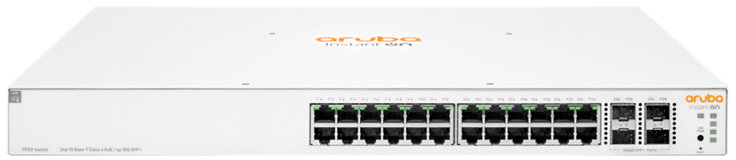
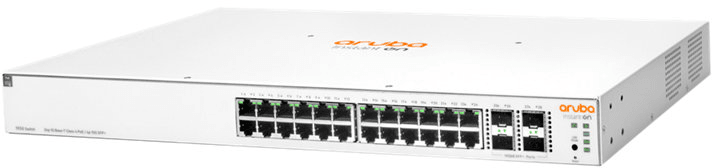
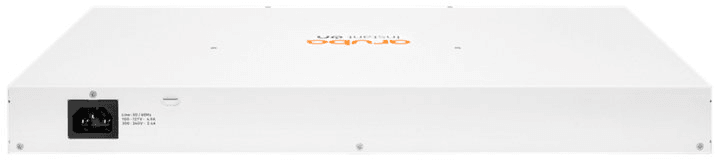
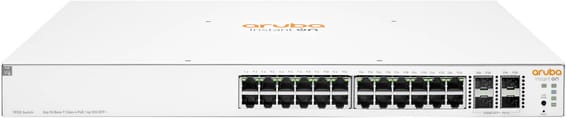
Aruba Instant On 1930 24-Port Class 4 PoE 4SFP/SFP+ Switch (JL684B)
Managed layer 2+ switch for SMEs and mid-sized companies, combining a large PoE power budget with full cloud management for dense Wi-Fi and IP infrastructures.
Managed layer 2+ (L2+), IPv4 static routing included
PoE+ up to 30 W per port, total budget of 370 W (IEEE 802.3af/at, class 4)
4 fibre uplinks at 1/10 Gbps (SFP/SFP+)
Management through the Instant On app and the cloud portal
The Aruba Instant On 1930 24-port PoE 370W is an L2+ managed switch aimed at SMBs and mid-sized companies, combining generous PoE+ power with full cloud management for wireless and IP infrastructures. 24 Class 4 PoE Gigabit RJ45 ports: each port delivers up to 30 W (IEEE 802.3af/at), with a total budget of 370 W to power Wi-Fi access points, IP cameras and VoIP phones at the same time, without external power supplies. 4 × 1/10 GbE SFP/SFP+ ports for very high-speed fibre uplinks to the distribution layer or network core. Managed through the Aruba Instant On app and cloud portal: 802.1Q VLAN, QoS, 8 LACP trunks, IGMP Snooping, STP/RSTP/MSTP, 802.1X, IPv4 static routing, 16,000-entry MAC table. 128 Gbps switching capacity, 95.23 Mpps throughput. 1U rack-mountable format. Ref. JL684B.
Be the first to review this product and help other customers.
Write a review
Frequently asked questions about this product
How many devices can the 370 W of PoE+ power?
370 W shared across the 24 ports, each delivering up to 30 W in Class 4. Twenty-four 12 W cameras stay under 300 W; a dozen power-hungry Wi-Fi access points exhaust the budget. 15.4 W 802.3af devices are supported in the same way.
Can PoE power to the cameras be cut outside business hours?
Yes, PoE scheduling lets you choose the day and time when each port powers the connected device. Power allocation follows LLDP-MED, the PoE class or actual consumption, as you prefer, and the highest priority level — critical — is automatically reserved for Instant On access points.
What speed do this model's 4 uplinks reach?
All four slots are 1G/10G SFP+: they accept a Gigabit fibre module as well as a 10-Gigabit module, so you can start at 1G and move to 10G without changing the switch. Latency drops below 1.3 µs on a 10G link, compared with 2.4 µs over Gigabit copper.
How many VLANs can be created, and in what ID range?
256 simultaneous VLANs, with IDs between 2 and 4093: the range is wide, but the number of active networks is capped at 256. A dedicated management VLAN restricts access to technicians, and the auto voice VLAN recognises IP phones to prioritise their traffic.
Can this switch let two VLANs communicate with each other?
Yes, with static IPv4 routing: each VLAN gets its own address, assigned manually or via DHCP, and the switch forwards traffic from one to another within a limit of 32 static entries. This is the hallmark of Layer 2+: segmenting no longer means going all the way up to the router.
How many ports can be aggregated towards the network core?
Eight ports per aggregate and eight aggregates on this 24-port model, with LACP or manual configuration. Uplink bandwidth is multiplied and the link survives the loss of a cable. 802.3x flow control limits packet loss when a node is saturated.
What IP address should I use for the first connection to the switch?
It boots as a DHCP client and takes the address provided by the router; with no DHCP server on the link, it falls back to the fixed address 192.168.1.1. Put your laptop on the same subnet to open the local web interface, which allows up to five simultaneous HTTP or HTTPS sessions.
Is a licence or subscription required for Instant On management?
No: all features are included in the price of the hardware, with no licence or subscription fees. Management is done from the Instant On mobile app, the hosted web portal or the switch's local web interface, the latter requiring no Internet access.
What filtering rules can be written on this switch?
Up to 50 access control lists, IPv4 and MAC, on ingress, totalling 480 rules, applicable to a port or a VLAN. They combine with 802.1X — with RADIUS-assigned VLAN —, the per-port allow list, DHCP snooping and dynamic ARP protection.
Are jumbo frames supported for backups?
Yes, up to 9,216 bytes: fewer packets to process on large transfers to a NAS or server, provided the network cards are set to the same size. The MAC address table holds 16,000 entries on this 24-port model.
How can this switch be located and diagnosed in a rack?
A locator LED can be set to on, blinking or off from the app, which singles out the right chassis among identical models. The Topology view and site inventory flag devices that have gone down, and port mirroring sends traffic to an analyser.
Is the switch new, and where can I view its documentation?
Yes, new equipment, with the invoice serving as the warranty document. The manufacturer's document details the Instant On 1930 series and lets you compare the 195 W PoE, 370 W PoE and non-PoE models: PDF datasheet.
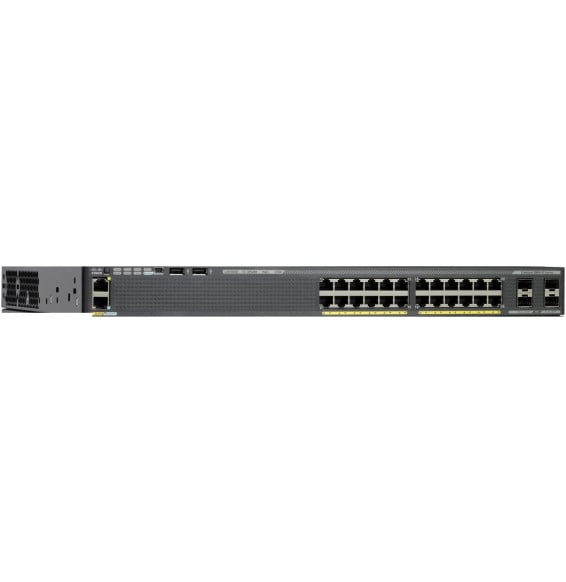
Cisco Catalyst 2960-X managed switch with LAN Base image: 24 Gigabit PoE+ ports with a 370 W budget, 4 SFP 1 Gbps uplink ports and FlexStack-Plus stacking of up to 8 switches. 1U, 5.8 kg, for a 19-inch rack.
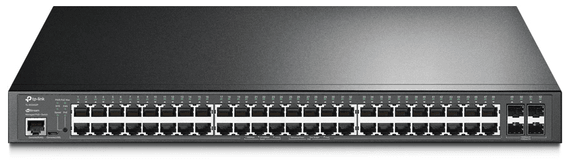
Designed for video surveillance: a 384 W PoE+ budget shared across the powered ports, transmission up to 250 m and power maintained even when the switch restarts. Rackable metal housing, VLAN and automatic loop prevention.
Aruba Instant On switch for small businesses: full L2+ managed from the mobile app, the cloud portal or a local web interface, with a more measured PoE budget for flexible deployment of Wi-Fi access points and IP cameras.
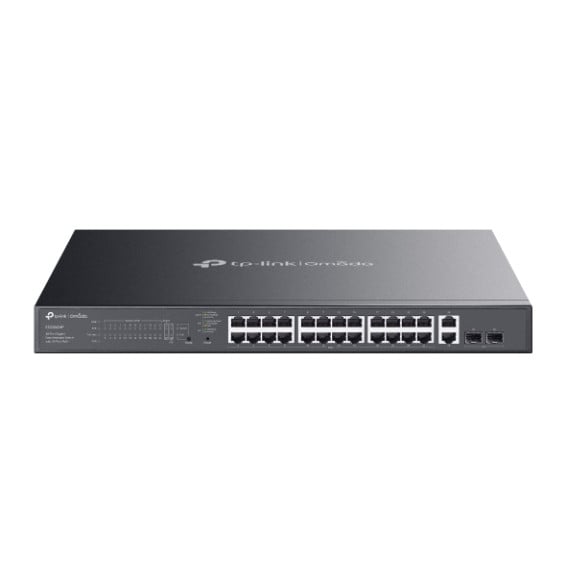
Total PoE+ budget of 384 W to power a large number of cameras, Wi-Fi access points and IP phones. 104 Gbps switching capacity, driven from the Omada SDN cloud.
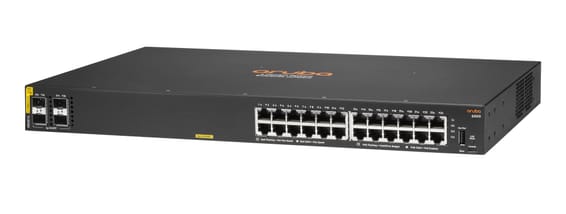
Managed access switch designed for SMEs and branch offices: powers workstations, Wi-Fi access points and IP cameras over Power over Ethernet, with centralised control from Aruba Central and automated deployment.
•Managed via Aruba Central (cloud or on-premise), web GUI, CLI and REST API
•PoE+ up to 30 W per port (IEEE 802.3af/at, class 4)
Fast PoE instantly powers cameras, Wi-Fi access points and IP phones over the network cable, with no break on restart. Four 10G links absorb traffic to the network core. Web, cloud app or command line control, built-in DoS/802.1X security.
Designed for SMEs and video surveillance, in a 19″ rackable format: automatic IP camera recognition, PoE consumption alarm and remote port restart through Ruijie Cloud.
Designed for enterprise networks, with advanced security and automatic recognition of IP cameras. Lifetime management through Ruijie Cloud for monitoring and remote updates.
Managed switch that powers its ports over PoE+ through the network cable, with two 2.5 Gbps combo ports for recent Wi-Fi access points. Configurable through the HUAWEI eKit App cloud or locally.