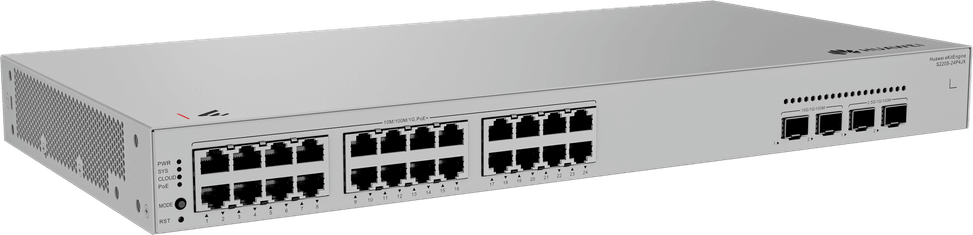
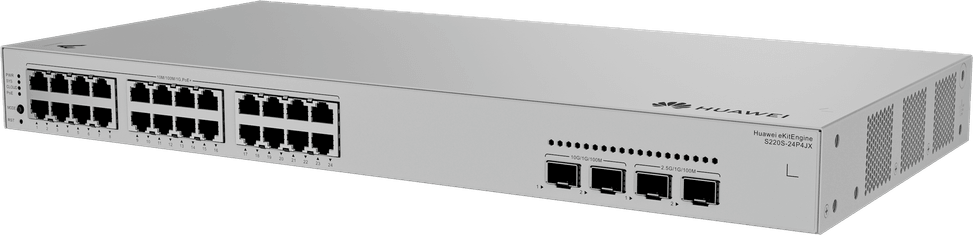
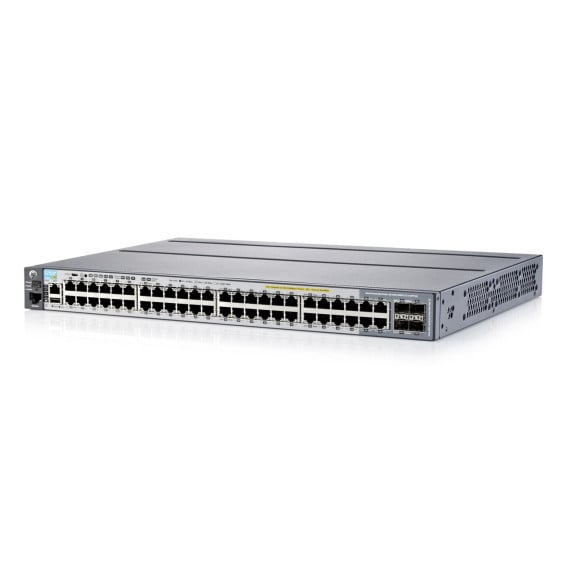
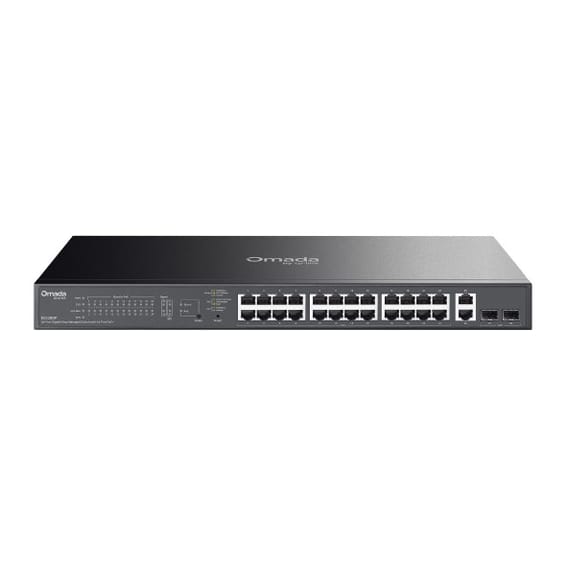
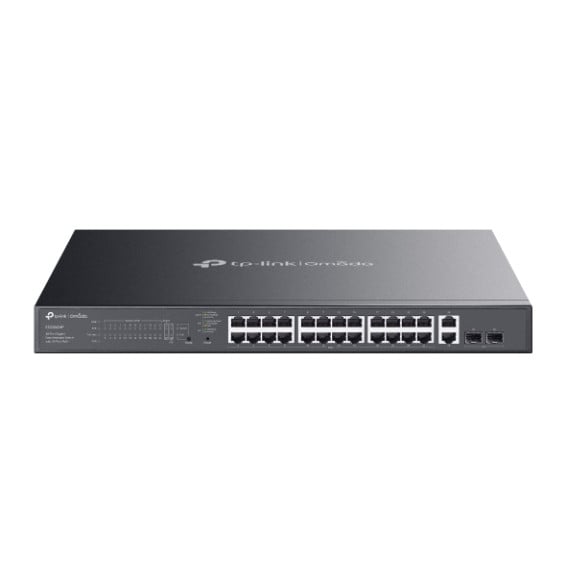
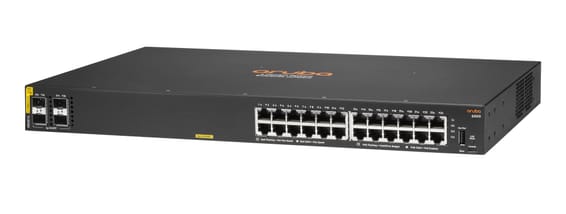
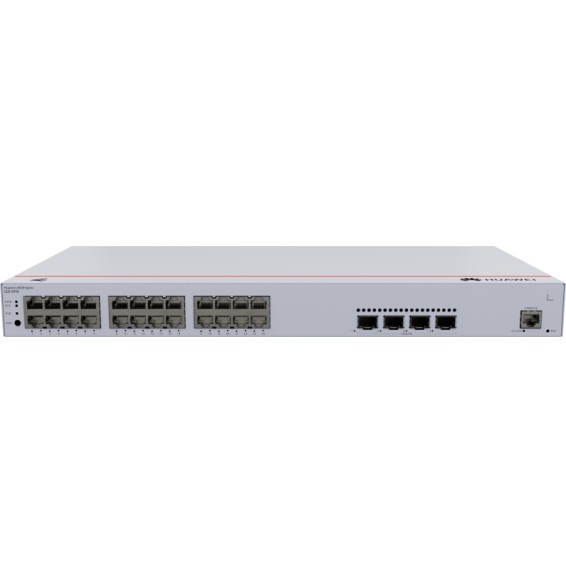
Managed switch that keeps your PoE equipment powered even during a restart (perpetual PoE), for continuity of service on critical cameras or Wi-Fi access points. Configurable through the HUAWEI eKit App cloud or locally.
24 Gigabit PoE+ RJ45 ports
2 SFP+ ports at 10 Gbps and 2 SFP ports at 2.5 Gbps for the uplink
Fast and perpetual PoE — power kept up during restarts
Managed — VLAN, QoS, ACL, DHCP snooping
Management through the HUAWEI eKit App (cloud or local), SNC, web interface
Huawei eKitEngine S220S-24P4JX managed switch: 24 Gigabit PoE+ ports, 400 W budget and 10G SFP+ uplinks — deploy a complete network infrastructure with built-in power for cameras, Wi-Fi access points and IP phones. Ports:24 Gigabit PoE+ RJ45 ports powering devices over the network cable, 2 x 10 Gbps SFP+ ports and 2 x 2.5 Gbps SFP ports for high-speed uplinks. PoE:400 W budget (802.3at) across the 24 PoE+ ports; Fast PoE keeps power flowing while the switch restarts. Management: via web interface, HUAWEI eKit App (cloud or local), SNC, HTTPS and SSH v2.0 — VLAN, QoS, ACL, DHCP snooping, advanced network security. Form factor:1U rack-mount chassis, active cooling with automatic fan speed. Also: switching capacity 98 Gbps, 73 Mpps, 16K MAC table, 4,094 VLANs, LACP, IGMP snooping, ERPS, Secure Boot, anti-DoS protection.
Be the first to review this product and help other customers.
Write a review
Frequently asked questions about this product
What does the “JX” suffix add compared with the S220S-24P4J?
The uplinks: this model combines two 10 Gbps SFP+ ports and two 2.5 Gbps SFP ports, whereas the 24P4J offers four 2.5 Gbps slots. Its switching capacity rises to 98 Gbps versus 68, for the same number of access ports and the same 400 W PoE budget.
Do the cameras stay powered while the switch restarts?
Yes. Perpetual PoE keeps connected devices powered when the switch restarts, including during a software update. This model also supports Fast PoE, which restores power without waiting for the boot process to finish — invaluable on a video surveillance network.
How is the 400 W of PoE+ shared across the 24 ports?
The 400 W budget is shared by all 24 ports, each delivering up to 30 W under 802.3at. Add up the actual consumption of your devices: 24 cameras at 12 W fit easily, while around fifteen power-hungry Wi-Fi access points use up the budget. A neighbouring model in the series, the 24LP4JX, is limited to 195 W.
How many VLANs and MAC addresses does this switch accept?
4,094 VLANs and a table of 16,000 MAC addresses, as static, dynamic or blackhole entries to keep out a specific machine. Learning and ageing follow the IEEE 802.1d standard, with no intervention from the administrator.
How do you protect the network against a fibre link failure?
With ERPS, standardised as ITU-T G.8032: on a ring topology, traffic fails over to the backup path within a few milliseconds. STP, RSTP and MSTP remain available for conventional architectures, and LACP aggregation combines several links into a single resilient connection.
Can this switch be managed without going through the cloud?
Yes: the HUAWEI eKit app works in cloud or local mode, and the web interface, SSH v2.0 and HTTPS remain directly accessible. You can switch between the two modes according to internal policy, without changing hardware — a point that matters when a department refuses any dependence on a hosted service.
What protections does this switch apply to the internal network?
Defence against denial-of-service, ARP and ICMP attacks, secure boot, port isolation, blackhole MAC addresses, AAA authentication and CPU protection. DHCP snooping keeps a binding table, rejects packets not listed in it and only allows the declared DHCP server.
How do you prioritise a traffic flow and throttle an overly chatty port?
Each interface has eight queues, rate limiting on transmit and receive, per-port traffic policing and IPv4 access control lists with packet filtering. At the same time, IGMP v1, v2 and v3 snooping prevents multicast from flooding every port.
Does this chassis have a fan, and where should it be installed?
Cooling is active, with regulated fan speed: plan for a rack cabinet or a comms room rather than a desk. It runs from -5 to +40 °C up to an altitude of 1,800 m, with 5 to 95 % humidity, non-condensing, in a 1U format measuring 442 × 220 × 43.6 mm.
Do you need an external power brick to power this switch?
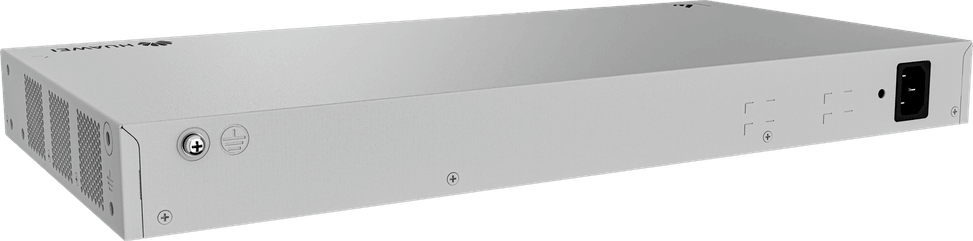
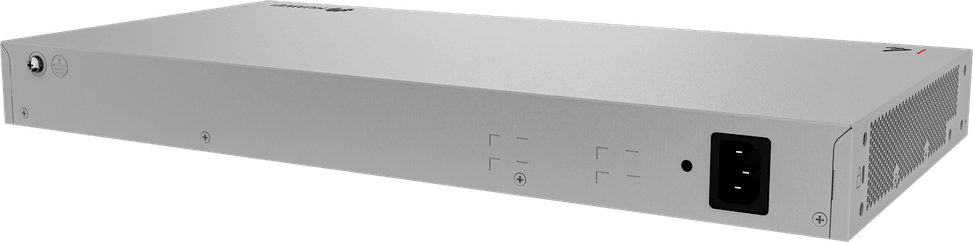
No, the power module is built in: a simple power cord is enough. The input accepts 100 to 240 V at 50/60 Hz and tolerates up to 290 V, and a 190 to 290 V high-voltage DC supply is also supported — useful in equipment rooms fitted with direct current.
Is the switch new, and where can I view its documentation?
Yes, new equipment, with the invoice serving as the warranty document. The manufacturer's document covers the entire eKitEngine S220S series, detailing the ports, PoE budgets and features of each model: datasheet (PDF).
Very fast, fully managed enterprise network: Multi-Gigabit 2.5 Gbps ports with PoE++ up to 60 W to power the most demanding Wi-Fi 6E access points and PTZ cameras. Full L3 routing.
Designed for enterprise networks, with advanced security and automatic recognition of IP cameras. Lifetime management through Ruijie Cloud for monitoring and remote updates.
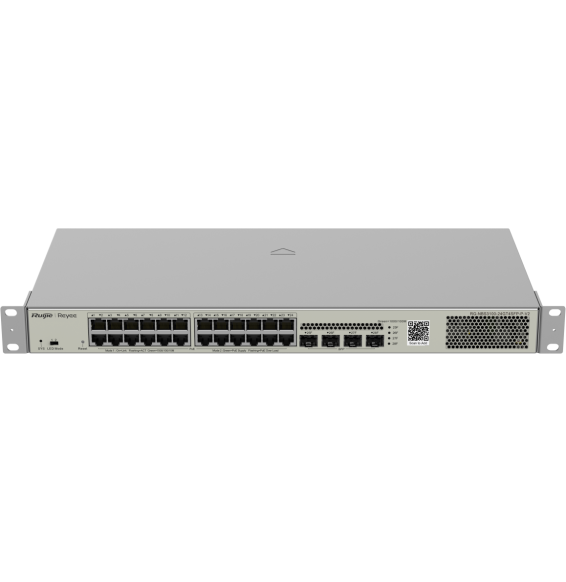
Designed for SMEs and video surveillance, in a 19″ rackable format: automatic IP camera recognition, PoE consumption alarm and remote port restart through Ruijie Cloud.
•PoE+ (802.3af/at standard)
•Managed through Ruijie Cloud, a mobile app or a web interface
Managed switch that powers its ports over PoE+ through the network cable, with two 2.5 Gbps combo ports for recent Wi-Fi access points. Configurable through the HUAWEI eKit App cloud or locally.
•22 Gigabit PoE+ RJ45 ports and 2 combo ports at 2.5 Gbps PoE+ (copper or fibre)
Layer 3 managed enterprise switch (static routing and RIP) that powers all its ports over the network cable, for cameras and Wi-Fi access points. Switching capacity 128 Gbps, upgradable to 10 Gbps fibre.
A managed enterprise switch that powers IP cameras, Wi-Fi access points and phones on every one of its ports, with no mains socket. Switching capacity 176 Gbps, stackable, upgradable to fibre.
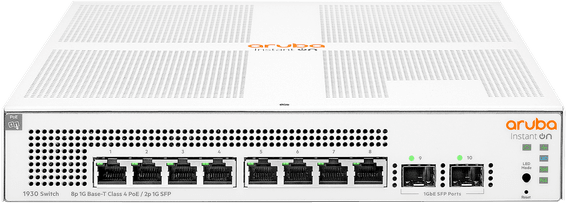
Compact rack-mountable format, completely silent and fanless, suited to open-plan offices and conference rooms — simplified control from the Aruba Instant On app, with no subscription.
Managed switch that powers its ports over PoE+ through the network cable, with two 2.5 Gbps combo ports for recent Wi-Fi access points. Configurable through the HUAWEI eKit App cloud or locally.
•22 Gigabit PoE+ RJ45 ports and 2 combo ports at 2.5 Gbps PoE+ (copper or fibre)
Designed for video surveillance: a 384 W PoE+ budget shared across the powered ports, transmission up to 250 m and power maintained even when the switch restarts. Rackable metal housing, VLAN and automatic loop prevention.
Managed access switch designed for SMEs and branch offices: powers workstations, Wi-Fi access points and IP cameras over Power over Ethernet, with centralised control from Aruba Central and automated deployment.
•Managed via Aruba Central (cloud or on-premise), web GUI, CLI and REST API
•PoE+ up to 30 W per port (IEEE 802.3af/at, class 4)
Fast PoE instantly powers cameras, Wi-Fi access points and IP phones over the network cable, with no break on restart. Four 10G links absorb traffic to the network core. Web, cloud app or command line control, built-in DoS/802.1X security.
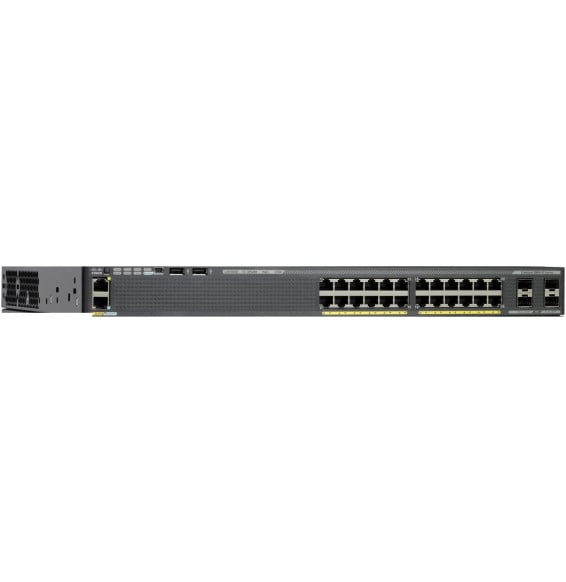
Cisco Catalyst 2960-X managed switch with LAN Base image: 24 Gigabit PoE+ ports with a 370 W budget, 4 SFP 1 Gbps uplink ports and FlexStack-Plus stacking of up to 8 switches. 1U, 5.8 kg, for a 19-inch rack.
Covers a whole floor of cameras, Wi-Fi access points and IP phones on a single device, without multiplying power units. 10G links and a capacity of 176 Gbps absorb the combined traffic. VLANs, security and administration of enterprise equipment.
Designed for SMEs and video surveillance, in a 19″ rackable format: automatic IP camera recognition, PoE consumption alarm and remote port restart through Ruijie Cloud.
Designed for enterprise networks, with advanced security and automatic recognition of IP cameras. Lifetime management through Ruijie Cloud for monitoring and remote updates.